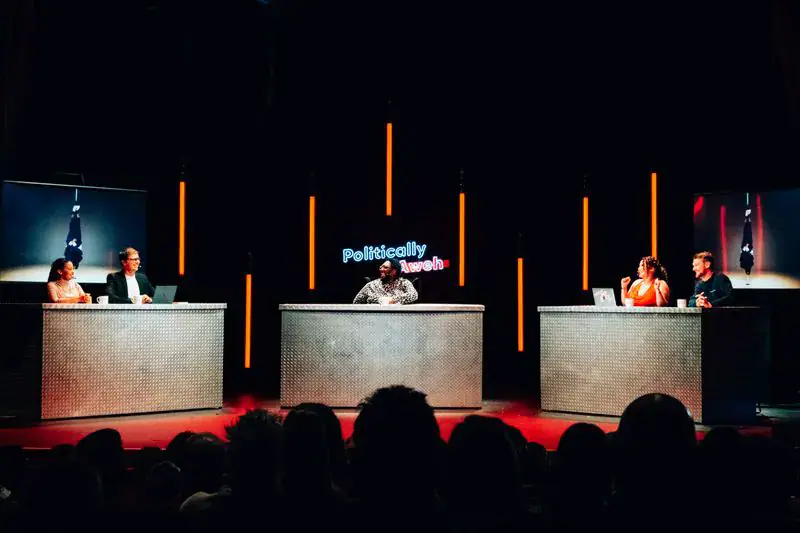
Politically Aweh, a popular South African comedy group, recently hosted a live elections comedy special called Poll Dancing at the Homecoming Centre in District Six, Cape Town. The event, which was attended by a sold-out crowd, featured comedians Yaaseen Barnes, Dillan Oliphant, and Lindy Johnson, as well as podcaster and author Dan Corder and Daily Maverick reporter Naledi Mashishi. The show was co-hosted by KG Mokgadi, Zoë Human, and Stephen Horn. The special aimed to educate viewers on various aspects of the elections, including how the ballot system works and the importance of understanding who funds political parties.
During the show, the hosts and guests discussed various issues affecting South Africa, including the high cost of living, service delivery crises, and the influence of social media on politics. KG Mokgadi, one of the co-hosts, even went as far as to announce his own mayoral campaign, albeit in jest. He promised to end the service delivery crisis by ending service delivery altogether, with every pothole filled with bobotie and anyone who can work out change from the front seat of a taxi receiving an automatic BCom. The show's lighthearted approach to serious issues was well-received by the audience.
One of the key issues discussed during the show was the impact of money on politics. The hosts noted that this election campaign has felt cheaper than previous ones, with parties relying more on bots and paid influencers rather than traditional campaign methods. KG Mokgadi referred to this as "election shrinkflation." The Political Party Funding Act, which came into effect in 2021, requires parties to disclose donations above a certain threshold. However, the rules have already been loosened, with parties now only having to disclose donations above R200,000, double the old threshold.
The show also touched on the issue of youth disengagement from politics. Naledi Mashishi, a Daily Maverick reporter, noted that many young people don't feel represented by any party or served by democratic institutions. She stressed that young people aren't uninterested in politics; they're looking for other ways to get involved. Voters are either staying home or splintering across smaller parties, which could lead to hung councils in many metros. Mashishi also noted that there's one metro where a single party might still win outright: eThekwini, where MK may take the majority of votes.
The housing crisis in Cape Town was another topic discussed during the show. The hosts noted that property prices in Cape Town have risen by about 31% in five years, roughly double the increase in other big metros. The city also has more than 27,000 Airbnb listings, which has led groups to call for rent control. However, Cape Town's mayor, Hill-Lewis, has firmly rejected it, arguing it makes housing shortages worse. Dan Corder suggested a specific fix: allowing short-term rentals only in the owner's primary home.
The spread of disinformation online was also a topic of discussion during the show. The panel noted that disinformation can spread quickly, often through social media bots and fake news. The Centre for Information Integrity in Africa at Stellenbosch University, one of the show's partners, has been tracking disinformation during the election. Researchers have flagged evidence of similar activity, including influencers being offered money to spread certain messages. Mashishi, a former fact-checker, advised viewers to be cautious when sharing information online, especially if it sounds inflammatory.
In conclusion, Politically Aweh's Poll Dancing comedy special provided an entertaining and informative look at the upcoming local elections in South Africa. The show's hosts and guests tackled various issues, from the ballot system to disinformation online. As the country prepares to go to the polls on November 4, shows like Poll Dancing serve as a reminder of the importance of active citizenship and critical thinking. KG Mokgadi's final message to the audience was a sincere one: "Democracy is hard, and we all need to work for it."
Key points
- The show aimed to educate viewers on various aspects of the elections, including how the ballot system works and the importance of understanding who funds political parties.
- The hosts and guests discussed various issues affecting South Africa, including the high cost of living, service delivery crises, and the influence of social media on politics.
- The show provided an entertaining and informative look at the upcoming local elections in South Africa, serving as a reminder of the importance of active citizenship and critical thinking.