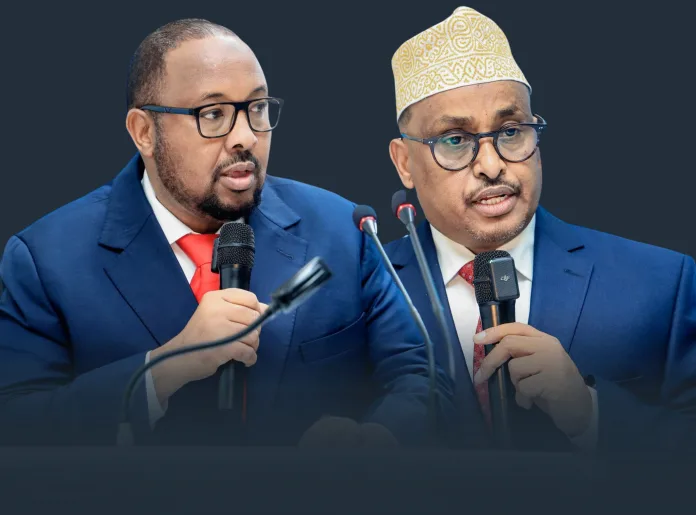
A deepening rift between President Abdiquadir Ahmed Aw-Cali (Firdhiye) of Somalia's Northeastern region, Waqooyi Bari, and his Vice President, Abdirahseed Yusuf Jibril (Abwaan), has raised concerns about the stability of the region. The disagreement centers around the management of government agencies, constitutional powers, and decision-making processes. This tension became apparent when President Firdhiye returned to Laascaanood, and it is linked to the appointment of the commander of the 26th division of the Somali National Army, which Vice President Abwaan opposed.
The conflict has spilled over into the regional parliament, with reports indicating that lawmakers have taken sides. Some legislators told Horseed Media that a motion against Vice President Abwaan has been submitted to the parliament's leadership ahead of the session. This development suggests that the rift is not only affecting the executive branch but also the legislative body. The involvement of lawmakers from different sides has added a new layer of complexity to the situation.
Efforts by local elders and community leaders from the Sool and Sanaag regions to mediate the conflict have so far been unsuccessful. These leaders had been working to create a conducive environment for dialogue to resolve the differences between the two leaders. However, their attempts have not yielded the desired results, and the situation remains tense. The failure of these efforts has raised concerns about the potential for the conflict to escalate further.
On October 7, Vice President Abwaan took to social media to address the speculation surrounding the conflict. He emphasized his commitment to the unity and existence of the Waqooyi Bari administration but did not directly respond to the allegations against him. This statement has done little to alleviate concerns about the deepening rift and its potential impact on the region's stability and governance.
The disagreement between the two leaders has significant implications for the region. The Waqooyi Bari administration plays a crucial role in maintaining stability and security in the area, and any prolonged conflict could undermine these efforts. The region has faced numerous challenges in recent years, including insecurity and humanitarian crises, and the current rift could exacerbate these issues.
The involvement of lawmakers and the apparent division within the parliament could further complicate the situation. If the conflict is not resolved, it could lead to a constitutional crisis and undermine the region's governance structures. The international community and local stakeholders are closely monitoring the situation, hoping for a peaceful resolution to the conflict.
The situation remains fluid, with no clear indication of how the conflict will be resolved. The fact that efforts by local leaders to mediate the conflict have failed suggests that a more robust and inclusive approach may be needed to address the underlying issues. The people of Waqooyi Bari are anxiously waiting for a resolution to the conflict, hoping that their leaders will find a way to put the region's interests ahead of their differences.
Key points
- The conflict between President Abdiquadir Ahmed Aw-Cali and Vice President Abdirahseed Yusuf Jibril has significant implications for the stability and governance of Somalia's Northeastern region.