Nigeria's political landscape is witnessing a surge in the number of relatives of prominent politicians contesting for seats in the National Assembly. As the 2027 general election approaches, the Independent National Electoral Commission (INEC) has released a list of candidates, showing a growing number of relatives of bigwigs in the race. This trend has sparked concerns about the rise of political dynasties and its implications for the country's polity. The list of candidates includes children of former presidents, governors, vice-presidents, Senate presidents, and other political heavyweights.
The battle for the National Assembly in 2027 is taking on the character of a generational contest, with sons and daughters of former presidents, governors, vice-presidents, Senate presidents, and other political heavyweights entering the electoral arena. From Ogun to Kaduna, Katsina to Delta, Abia to Benue, and Ondo to Edo, political surnames that have shaped Nigeria's political history are returning to the ballot. This phenomenon raises a fundamental question: Is Nigeria's political class renewing itself or simply reproducing itself? The trend is no longer confined to a few famous families, with many children of prominent political figures linked to Senate and House of Representatives contests.
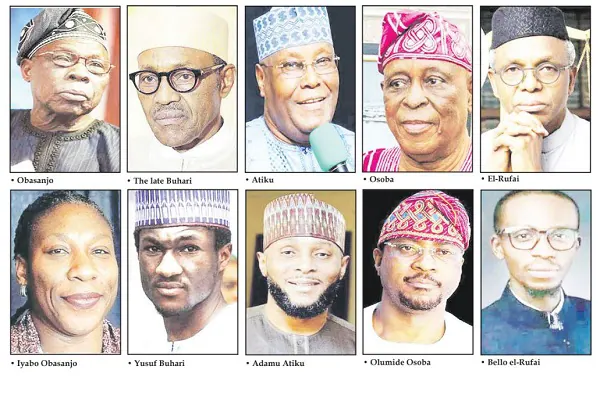
A compilation by the International Centre for Investigative Reporting (ICIR) identified many children of prominent political figures linked to Senate and House of Representatives contests ahead of the 2027 elections. The list includes former President Olusegun Obasanjo's daughter, Iyabo Obasanjo, contesting the Ogun Central Senatorial District; former President Muhammadu Buhari's son, Yusuf Buhari, linked to the Daura/Sandamu/Mai'adua Federal Constituency in Katsina; and former Kaduna Governor Nasir El-Rufai's son, Bello El-Rufai, who represents Kaduna North in the House of Representatives.
Other notable children of prominent politicians contesting for National Assembly seats include former Vice-President Atiku Abubakar's son, Adamu Atiku; former Abia Governor Theodore Orji's son, Chinedum Orji; former Delta Governor James Ibori's daughter, Erhiatake Ibori-Suenu; and former Ogun Governor Olusegun Osoba's son, Olumide Osoba. The list also includes former Oyo Governor Adebayo Alao-Akala's son, Olamiju Alao-Akala; former Senate President David Mark's daughter, Blessing Onuh; and late Ondo Governor Adebayo Adefarati's son, Adegboyega Adefarati.
The family advantage is significant in Nigeria's politics, with political heirs often inheriting a recognisable name, political contacts, loyal supporters, campaign machinery, access to party leaders, and relationships with influential stakeholders. This advantage is particularly significant in a political system where party structures and electoral contests require enormous resources. However, pedigree is not an automatic guarantee of electoral success, as some children of prominent politicians have lost primaries or failed to secure nominations.
The concern about political dynasties is that they may shrink the political space for ordinary Nigerians, giving structural advantages to children of politicians that are unavailable to others. A political analyst, Josiah Etim, argued that while politicians' children have the right to contest, the repeated transfer of political positions within families could amount to perpetuating oligarchy and shrinking the political space for outsiders. This debate has become sharper as more political families position their children for office.
The 2027 contests are attracting children of political figures whose own careers may have peaked years ago, with the objective of securing a seat in the National Assembly for the next generation and ensuring the family's political influence survives the retirement or death of its founding generation. This trend has sparked concerns that elections could gradually become contests between political dynasties rather than contests between competing ideas.
Key points
- The rise of political dynasties in Nigeria's National Assembly contests has sparked concerns about the shrinking of political space for ordinary Nigerians.
- Children of prominent politicians are leveraging their family names and networks to contest for seats in the National Assembly.
- The trend has raised questions about whether Nigeria's political class is renewing itself or simply reproducing itself.