A recent knife attack at a Benedictine monastery in Jaroslaw, Poland, has brought attention to the complicated relationship between Poland and Ukraine. A 31-year-old Ukrainian citizen killed a priest and injured four others, and a court has ordered him held in pretrial detention for three months. The motive for the attack remains unclear. The incident has sparked reactions from Polish politicians and nationalists, with some calling for tighter controls on migrants, including Ukrainians.
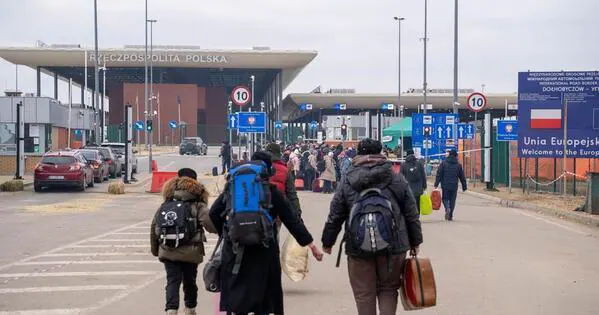
Poland has been a major supporter of Ukraine and a key logistical hub for assistance, but solidarity is giving way to harder politics. When the Russia-Ukraine conflict escalated in 2022, Poland introduced special measures for Ukrainians fleeing the fighting, including access to employment, public healthcare, and social benefits. Initially, public support was overwhelming, with 94 percent of respondents supporting accepting Ukrainian refugees. However, what began as temporary refuge has evolved into a longer-term challenge of migration and integration.
The number of people displaced from Ukraine under temporary protection in Poland has remained high, with over 953,000 individuals at the end of July, the second-largest number in the European Union after Germany. Public attitudes have shifted, with 52 percent of respondents opposing accepting Ukrainian refugees in a recent survey. This change has been accompanied by growing hostility toward Ukrainians, with 180 reports of suspected hate crimes targeting Ukrainian citizens in the first half of 2026, up more than 30 percent from the same period a year earlier.
Historical disputes have further fueled friction between Poland and Ukraine, particularly over the Volhynia massacres during World War II and the legacy of the Ukrainian Insurgent Army (UPA). Ukrainian President Volodymyr Zelensky approved the naming of a Ukrainian military unit after the UPA in late May, prompting Polish President Karol Nawrocki to revoke the Order of the White Eagle, Poland's highest state decoration, which was awarded to Zelensky in 2023. Zelensky returned the decoration the following day.
A study by the Carnegie Endowment for International Peace found that security remains an area where Polish and Ukrainian strategic interests are closely aligned, but this appears to be the lowest common denominator in their relationship. Differences have emerged even over security, with some Polish officials viewing Ukraine as a buffer state rather than a full-fledged ally integrated with Europe. Economic relations also reveal limits to the partnership, with disputes over Ukrainian agricultural exports and tensions over increasing Ukrainian grain transit through Poland.
The stakes extend beyond bilateral relations, with tensions between Poland and Ukraine carrying potential implications for Ukraine's accession to the EU. Polish geopolitical analyst Malwina Talik noted that the dispute over historical memories of the UPA is particularly difficult to resolve. The asymmetry between Poland and Ukraine has grown, with Poles primarily concerned with avoiding direct confrontation, while the conflict remains an existential issue for Ukrainians.
As Poland and Ukraine navigate their complex relationship, they must balance their strategic interests with domestic politics and historical grievances. The recent knife attack has highlighted the need for both countries to address their differences and find common ground. With Poland's general elections approaching, the issue of Ukrainian migration and integration is likely to remain a contentious topic in Polish politics.
Key points
- A knife attack at a Polish monastery by a Ukrainian national has strained relations between Poland and Ukraine.
- Growing differences over migration, economic interests, and historical grievances are contributing to the fraying of Polish-Ukrainian solidarity.
- The tensions between Poland and Ukraine carry potential implications for Ukraine's accession to the EU.