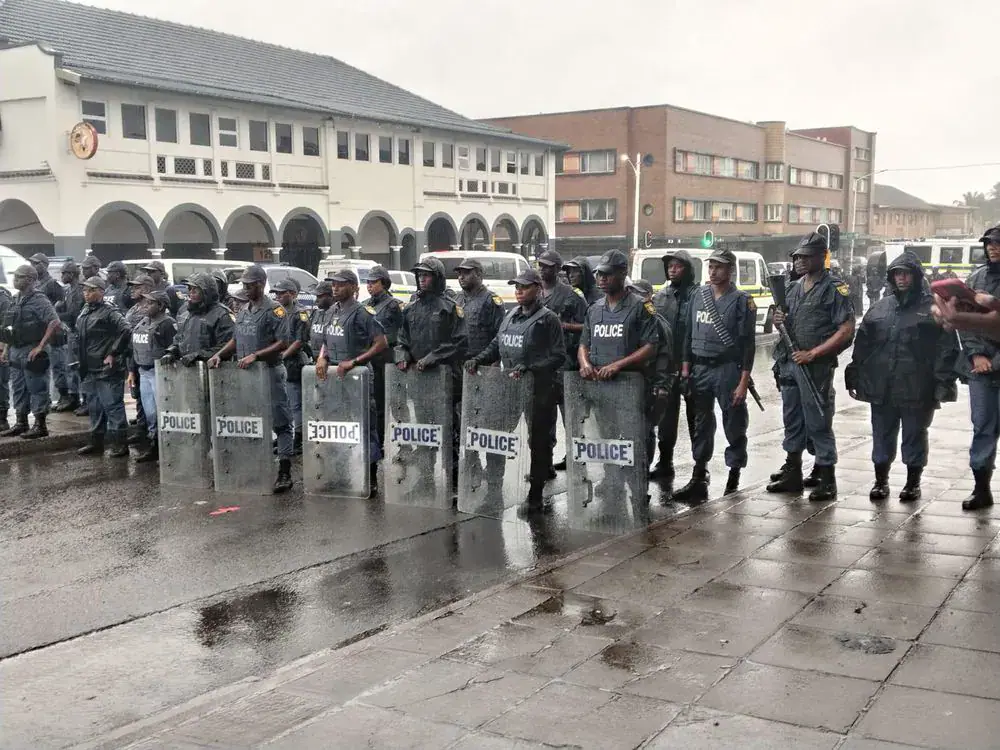
The South African Police Service has told the Durban High Court that it is struggling to manage large crowds during repeated March and March demonstrations, citing the need for pre-emptive action to prevent further violence and lawlessness. The police are seeking an urgent interdict against the movement and its leaders to restrain them from marching and from assaulting or intimidating public officials and members of the public.
According to Advocate Nalini Govender, representing the Minister of Police and the KwaZulu-Natal provincial commissioner, reactive policing has become ineffective in responding to the demonstrations. Govender argued that deploying police to respond to and disperse unruly crowds after violence has erupted has not been successful, and that rubber bullets and tear gas have not been able to undo the damage done.
Judge Peter Olsen questioned the police's strategy, pointing out that being armed during a gathering is an offence and asking why protesters were not disarmed and arrested. Govender replied that managing the crowds remains difficult despite the substantial deployment of police officers, and that the police are outnumbered. She cited the need for pre-emptive action to prevent further violence.
The court heard that there are notices for further demonstrations, including one covering demonstrations until December 2025 and another for October 2026. Govender expressed concern that police resources are already stretched ahead of the elections and that the continued reactive response to the demonstrations is depleting those resources.
Govender argued that the marches, which are directed at foreign nationals, are also affecting ordinary members of the public, causing perpetual fear and impacting smaller businesses. She said that participants in the demonstrations rely on section 17 of the Constitution, which guarantees the right to assemble, demonstrate, picket, and present petitions, but that their actions have been characterized by lawlessness and chaos.
The police are seeking to restrict the March and March movement and its leaders from engaging in violent and intimidating behavior, citing the need to protect ordinary citizens and public officials. Judge Olsen sought clarity on the relief the applicants are asking the court to grant, questioning what permanent relief they intend to pursue after the interim order.
The matter has been stood down for Govender to take instructions on the issue, with the respondents yet to present their arguments. The March and March movement has been the subject of controversy, with some groups, such as the MK Party, backing the movement in the court interdict battle.
Key points
- The South African Police Service is seeking an urgent interdict against the March and March movement and its leaders to prevent further violence and lawlessness.
- The police claim that reactive policing has become ineffective in responding to the demonstrations and that pre-emptive action is needed.
- The March and March movement has been characterized by lawlessness and chaos, despite participants relying on the constitutional right to assemble and demonstrate.