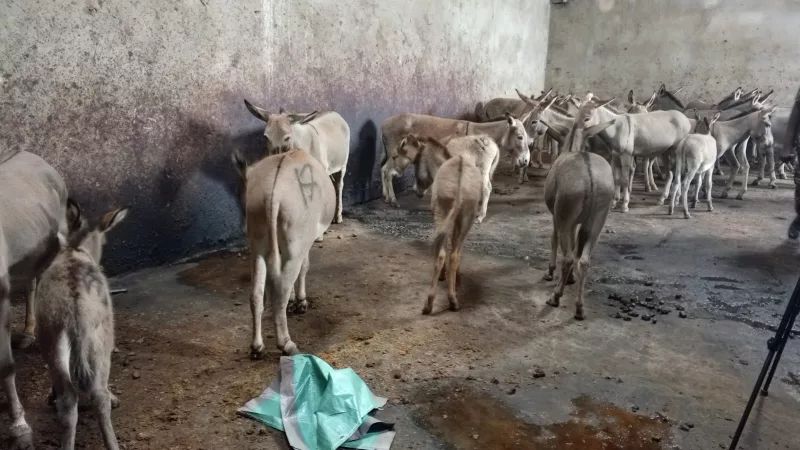
On Wednesday, September 23, 2026, a multi-agency team comprising officers from the National Police Service, National Government Administration Officers, and Kiambu County Government raided a warehouse in Kalimoni Ward, Juja Sub-County, Kiambu County. The raid was conducted following reports of donkey carcasses being dumped at various locations within Juja, indicating that some meat consumed in the area could be from donkeys.
Inside the gated compound, measuring approximately 50 by 70 feet, officers discovered 30 live donkeys of different ages kept inside a two-storey building. The animals were reportedly in poor condition and appeared to have been deprived of food, raising suspicions that they were being prepared for slaughter. Police also recovered several blood-stained knives and clothing, sacks containing donkey slaughter waste, polythene bags, and waterproof paper bags suspected to have been intended for packaging donkey meat.
A jerrycan containing sulphuric acid was also found at the premises, with investigators suspecting the chemical may have been used to suppress the smell of meat and slaughter waste. No suspect was found at the premises during the raid; however, a neighbour told officers that activities at the compound were usually heard at night, approximately once a week.
The 30 live donkeys were rescued and moved to a nearby private farm, where they will be fed and kept safely as authorities make arrangements for their disposal. Crime scene investigation officers from Juja processed and documented the scene as investigations continue. Monitoring of the area and efforts to identify those behind the suspected illegal slaughter operation are ongoing.
Donkey meat is not illegal in Kenya; however, the country's donkey population is under threat. A new study on the theft and illegal trade in donkeys and donkey products has called for sweeping legal, policy, and enforcement reforms, warning that Kenya risks losing its donkey population unless authorities dismantle organised criminal networks behind the illicit trade.
The study found that criminal syndicates driven by high international demand for donkey hides operate through clandestine slaughterhouses and cross-border smuggling networks that circumvent veterinary inspections and leather industry regulations. Kenya's donkey population fell from 1.8 million in 2009 to 1.1 million in 2019, depriving rural households of an essential source of transport, farm labour, and income.
The National Crime Research Centre (NCRC) launched a landmark report detailing the extent of theft and illegal trade in donkey skins and related products in Kenya. The report recommended coordinated action by government agencies, law enforcement, prosecutors, border control authorities, and civil society to curb the illicit trade, including a comprehensive Donkey Protection Law and specific offences and tougher penalties for donkey theft and illegal slaughter.
Key points
- 30 live donkeys were rescued from an alleged illegal donkey slaughterhouse in Juja, Kenya.
- Kenya's donkey population has declined sharply due to the illicit trade, from 1.8 million in 2009 to 1.1 million in 2019.
- Authorities are seeking to identify and apprehend the proprietor of the facility and other individuals suspected to be involved in the alleged illegal slaughter and meat trade.