A bitter spat between Poland's pro-Europe Prime Minister Donald Tusk and pro-Trump President Karol Nawrocki has erupted into a constitutional crisis. The crisis centers on the country's highest court, the Constitutional Tribunal, which has been at the heart of a long-running dispute over the rule of law in Poland. Tusk's pro-European Civic Coalition was elected in 2023, promising to restore the Tribunal's independence. However, Nawrocki, who belongs to the far-right Law and Justice party (PiS), has refused to cooperate.
The current crisis began when Tusk moved to remake the Constitutional Tribunal, whose chief justice, Bogdan Święczkowski, was appointed by the previous PiS government. Święczkowski was suspended after refusing to allow a new member of the Tribunal, nominated by Tusk and approved by the Polish parliament, from taking his seat. His deputy was also suspended. Nawrocki described Święczkowski's removal as "a forcible takeover of a constitutional body" and abandoned a trip to Africa to head to the Tribunal.
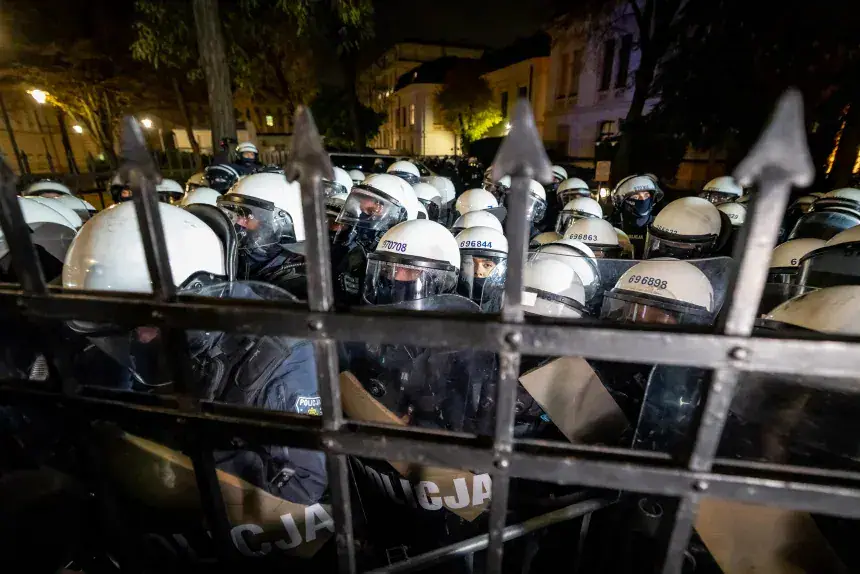
The dispute has been ongoing since Tusk's election, with Nawrocki refusing to swear in three of six judges nominated by parliament, while Święczkowski declined to seat the judges chosen by parliament. The crisis deepened when parliament approved the nomination of Maciej Berek, a close ally of Tusk, which analysts say contradicts the government's pledge to depoliticize the Tribunal. Riot police have reinforced security measures around the court in central Warsaw.
Tusk has spent much of his time as Prime Minister trying to unstitch the PiS changes to the judiciary. He said his government was seeking to restore the rule of law, stating that "shouting, lies, and brawling cannot be the source of law in Poland, and they never will be." He insisted the Tribunal "will function as it should. Also, independently of me and in line with the constitution." The US ambassador to Poland, Tom Rose, warned that the situation was "already dangerous" and urged calm.
The European Union has been critical of PiS' actions, warning that they posed a "systemic risk to the rule of law in Poland" and undermining the Tribunal's independence. The European Commission froze $137 billion in EU funding for Poland over concerns about the independence of Polish judges. Analysts say the crisis has implications for Poland's future, with fresh elections due next year and the country's constitutional order and political direction high on the agenda.
The standoff between Tusk and Nawrocki has raised concerns about Poland's growing security threats, including the war in Ukraine and sabotage attacks inside Poland attributed to Russia. Tusk said his opponents find support among pro-Russian forces around the world. The situation remains unclear, with neither side seeming ready to compromise. The US ambassador's warning of a potentially combustible situation has added to the urgency of finding a resolution.
As the crisis continues, Poland's future direction remains uncertain. The country's constitutional order and its political direction – towards or away from deeper integration with Europe – are high on the agenda for next year's elections. The international community is watching closely, with the European Union and the United States having significant interests in the outcome. The situation in Poland remains volatile, with the potential for further escalation.
Key points
- The crisis centers on the independence of Poland's Constitutional Tribunal.
- The European Union has frozen $137 billion in funding over concerns about Polish judicial independence.
- The standoff has implications for Poland's future, including its constitutional order and political direction.