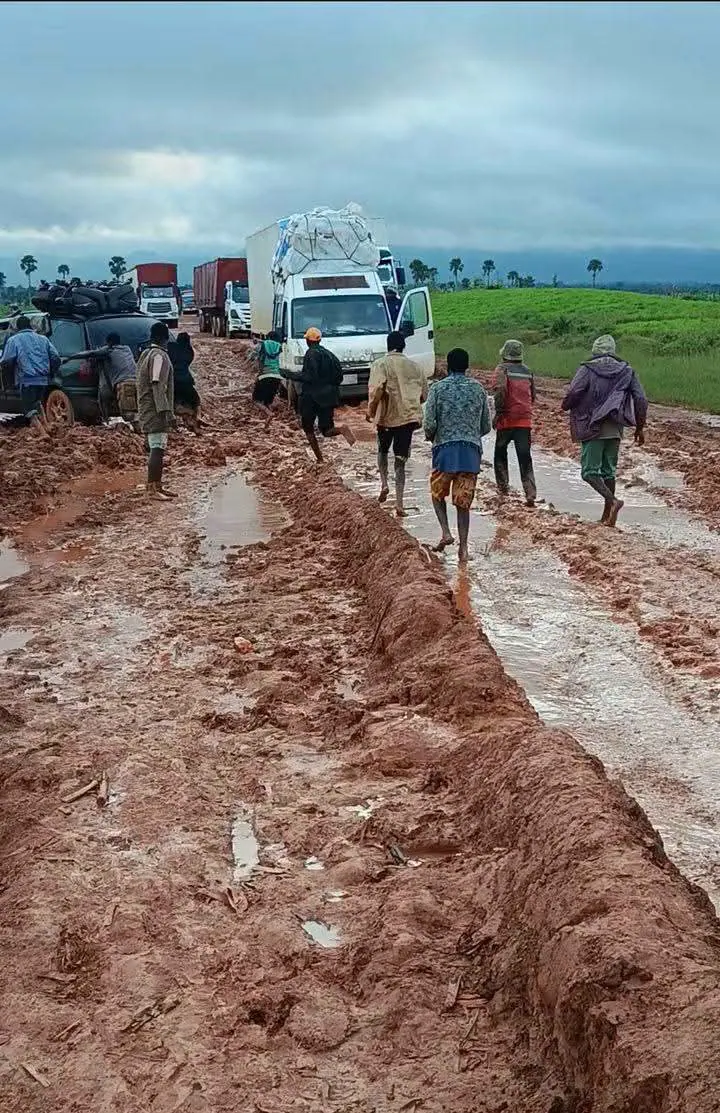
The Vom-Ganawuri-Manchok road, a 52-kilometre highway connecting Plateau State with Kaduna and the wider Middle Belt, has fallen into a deplorable state. Motorists are now stranded for hours and sometimes days due to the road's condition. Heavy-duty vehicles sink at several failed sections along the route, causing significant disruptions to transportation and economic activities. The road was reconstructed and commissioned in 2013 under President Goodluck Jonathan and was described as a "world-class standard" highway by then Minister of Works, Mike Onolememen.
The road's deterioration has significant economic implications, particularly for communities along the corridor, including Vom, Ganawuri, and Manchok, which are major food-producing areas in Nigeria. These communities produce yam, maize, rice, Irish potatoes, and ginger commercially, but with the road in poor condition, farmers struggle to move their produce to markets in Jos, Kaduna, Abuja, and beyond. This has resulted in losses for farmers and increased food prices for consumers. The road is the shortest route between Jos and Kaduna, reducing travel time to about two and a half hours, but alternative routes through Saminaka or Kagoro take more than four hours.
Signs of deterioration emerged barely two years after the road's commissioning, when the asphalt began peeling away. The worst-affected section is around Danton Village and Ganawuri Hills in Riyom Local Government Area of Plateau State, about 31 kilometres from Jos. A 100-metre section has become a muddy quagmire, and during the rainy season, youths from nearby villages operate an unofficial toll gate, collecting N200 or more from motorists to help pull vehicles out of the mud.
The road's poor condition has also become a hotspot for armed robbery and accidents. Commuters have noted that slow-moving vehicles are easier targets for criminals, and the same areas have recorded fatal accidents. The Federal Road Safety Corps has reported multiple tanker explosions and deaths around the Ganawuri Hills axis. As a result, traders from Kaduna and Plateau are increasingly diverting from or abandoning the route, disrupting inter-state trade and weakening the North-Central's position as a major food supplier.
The economic impact of the road's deterioration is already evident, with farmers losing income when produce spoils before reaching markets, and traders losing customers as market activity declines. Consumers pay more for food that should otherwise be cheaper, and the road's deterioration increases transportation costs across the region. Analysts describe the road's deterioration as an economic emergency, stating that it is no longer simply a transportation problem but a broader economic issue.
Stakeholders in Riyom and Kaura LGAs are calling for urgent intervention, demanding that the Federal Government, Federal Ministry of Works, and FERMA declare a state of emergency and undertake complete reconstruction rather than palliative repairs. They warn that the next farming season could be severely affected if the road is not reconstructed. For now, motorists using the road are advised to consider alternative routes, as the Vom-Ganawuri-Manchok road remains a major hazard.
The road's collapse threatens the next farming harvest, and if farmers cannot access markets, produce could rot. If trucks cannot move, traders may stay away, and if robberies and accidents persist, lives and goods could be lost. The contrast between the road's condition in 2013, when it was described as a "world-class standard" highway, and today, when motorists describe it as a death trap, is striking.
Key points
- The road's poor condition has significant economic implications for communities along the corridor.
- The road's deterioration has resulted in losses for farmers and increased food prices for consumers.
- Stakeholders are calling for urgent intervention and complete reconstruction of the road.