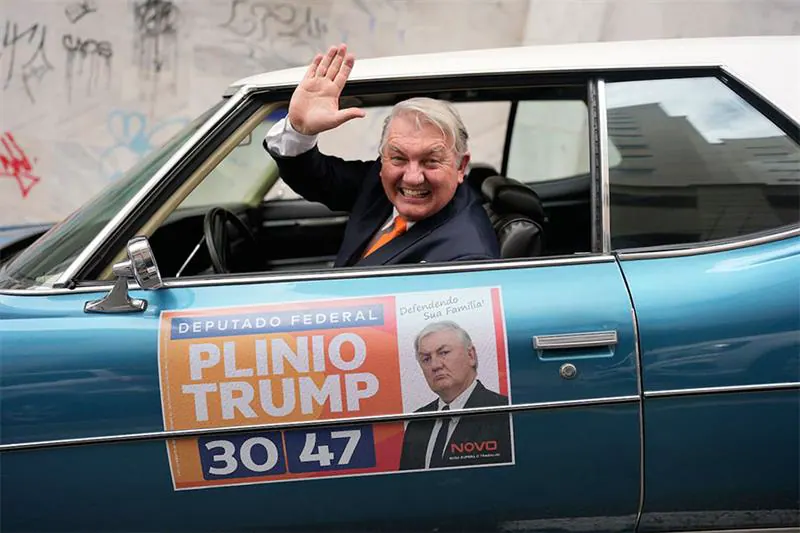
In a bizarre display of creativity, Brazilian candidates are embracing humor and satire in their campaigns, echoing a tradition that spans nearly eight decades. Plínio Vicentin Júnior, a 59-year-old helicopter pilot, is running for federal lawmaker as "Plínio Trump," donning a hairstyle, long orange tie, and firm handshake reminiscent of the former US President Donald Trump. With his vintage Pontiac Grand Ville and American flag fluttering near his windshield, Plínio Trump is campaigning from his car, drawing smiles and hugs from onlookers.
Plínio Trump is not alone in his quest for office; other novelty candidates are also making waves in Brazil's congressional elections. Henrique Barack Obama, born Cláudio Henrique dos Anjos, is seeking a Senate seat in the Federal District, despite bearing little resemblance to the former US President. Another candidate, Mick Jagger, whose real name is Walcy Calixto Vieira, is running for a seat in the legislature of the central state of Goias. These candidates, while entertaining, also highlight the complexities of Brazil's electoral system.
Brazil's tradition of novelty candidates dates back to 1959, when roughly 100,000 voters in São Paulo wrote the name of Cacareco, a female rhinoceros from the city zoo, on their paper ballots in a city council election. The movement gained momentum in 1989 with Dr. Enéas Carneiro, a respected cardiologist who delivered rapid-fire, complex speeches that many Brazilians found hilarious. Carneiro pulled in 360,000 votes in Brazil's first direct presidential election since 1960 and went on to secure 4.6 million votes in 1994.
The phenomenon of joke candidates reached a new high in 2010, when Tiririca, a circus clown and comedian, won a congressional seat for São Paulo with more than 1.3 million votes. His campaign slogans, including "It can't get any worse" and "What does a federal congressman do? I really don't know. Vote for me and I will find out for you!" resonated with voters. Tiririca served four consecutive terms and is seeking a fifth term, representing his native Ceara state.
According to Carlos Melo, a political science professor at Insper university in São Paulo, candidates like Tiririca punch above their weight due to Brazil's proportional representation system. Votes for candidates go to their party and are then distributed proportionally, allowing some candidates to secure seats or help their parties secure a bigger slice of Congress and public funds. Melo notes that traditional political leadership is decomposing, leading to more bizarre candidates.
This year's elections feature over 7,800 candidates running for a seat in Congress, with many more running for state legislatures. Some candidates, like Samurai Taxi Driver, a nunchaku master featured in Instagram videos, are running for the state legislature in Pernambuco. Others, like "Tsunami Grandmother" and "Lonely Boy," are also vying for office. These candidates may not win, but they add to their parties' total under Brazil's electoral system.
As Plínio Trump wrapped up campaigning in Juiz de Fora, he acknowledged that his decision to campaign as the US President goes beyond physical resemblance. "We have few options on the right in Brazil," he said. "For me, Trump is a right-wing reference." With the general election just around the corner, Brazil's joke candidates are sure to continue entertaining voters and highlighting the complexities of the country's electoral system.
Key points
- Brazil's tradition of joke candidates dates back to 1959 and has continued to evolve over the years.
- These candidates, while entertaining, also highlight the complexities of Brazil's electoral system and proportional representation.
- The phenomenon of joke candidates has become a staple of Brazilian politics, with many candidates using humor and satire to connect with voters.