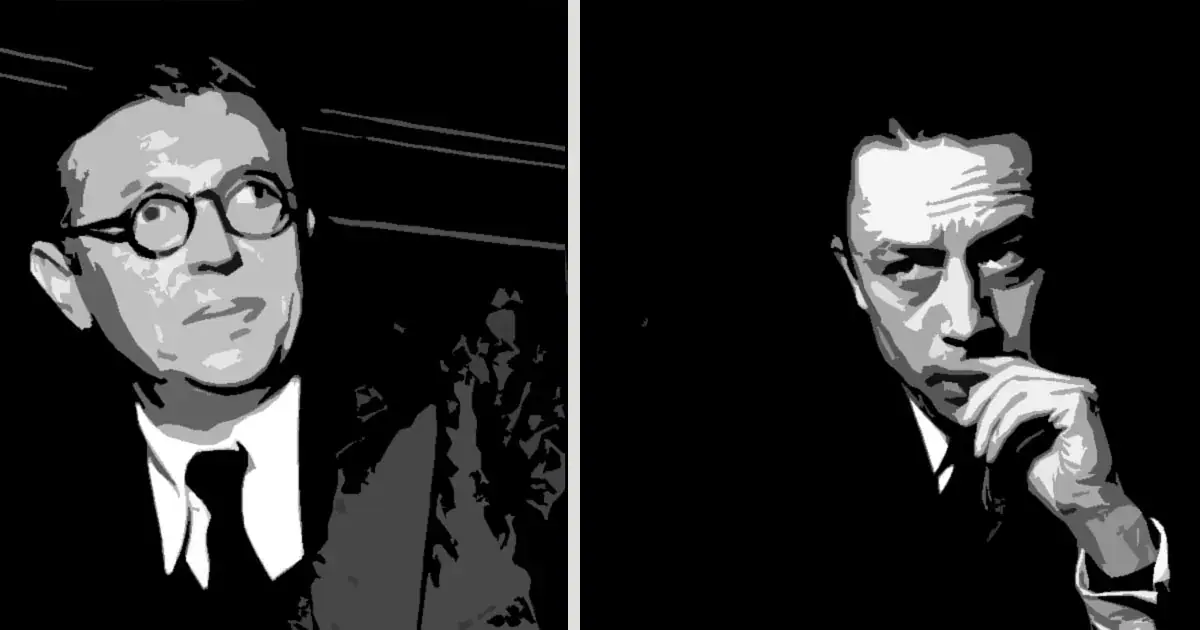
The 20th century was marked by significant upheaval, with two world wars, massive destruction, and moral crises that profoundly changed Western perspectives on human destiny. Jean-Paul Sartre and Albert Camus, two influential philosophers, developed major philosophies that continue to fuel debates today. Both placed humans at the center of their reflections, rejecting easy answers and artificial consolations. However, they proposed different paths to confront the difficulty of existence. Their thoughts were shaped by the intellectual atmosphere of the post-war period.
Sartre, a key figure in existentialism, based his philosophy on the idea that existence precedes essence. This means that humans arrive in the world without a predefined nature and construct their existence through choices and actions. In contrast, Camus refused to be labeled an existentialist, instead developing a philosophy of absurdism. He focused on the experience of confronting the desire for meaning with the silence of an unresponsive universe. Camus' work, "The Myth of Sisyphus," analyzed the fundamental contradiction between humanity's search for clarity and the world's indifference.
The difference between Sartre and Camus lies in their approaches to understanding human existence. Sartre emphasized human freedom, explaining how individuals can construct their existence through choices. Camus, on the other hand, started from the absence of definitive answers, showing how humans can live with dignity despite this uncertainty. Despite their divergence, the two philosophers shared a common context and intellectual environment. They were both concerned with human responsibility after the catastrophes of the 20th century.
Sartre's philosophy began with a rejection of the idea that humans possess a fixed essence before existence. He argued that humans appear in the world without prior definition and become what they choose to be. This conception gives freedom a central role, but also leads to anxiety. Humans are "condemned to be free," meaning they must take responsibility for their choices and actions. Sartre's philosophy emphasizes the dynamic nature of human existence, where individuals construct their identity through action.
Sartre's concept of "bad faith" refers to the attitude of individuals who try to escape their responsibility by convincing themselves that they are fixed entities. He argued that this attitude constitutes a flight from freedom. In contrast, Camus began his reflection with the experience of the world's strangeness. Humans seek coherence and meaning, but often encounter silence. This encounter gives rise to what Camus called the absurd. The absurd is not the idea that life is useless, but rather the confrontation between human expectations and the world's indifference.
Camus' philosophy focuses on living with dignity in the face of absurdity. He argued that humans must acknowledge and accept the absurd, rather than trying to escape or deny it. This acknowledgment allows individuals to live with freedom and responsibility, creating their own meaning in life. Camus' work emphasizes the importance of living in the present and finding ways to live with dignity despite the uncertainty of the world.
The philosophies of Sartre and Camus continue to influence contemporary debates on human existence and responsibility. Their ideas on freedom, absurdity, and human dignity remain relevant today. Both philosophers emphasized the importance of human choice and action in shaping existence. Their work encourages individuals to take responsibility for their lives and to live with authenticity and dignity.
Key points
- Sartre's philosophy emphasizes human freedom and the responsibility that comes with it.
- Camus' philosophy focuses on living with dignity in the face of absurdity.
- Both philosophers rejected easy answers and artificial consolations, instead emphasizing human choice and action.