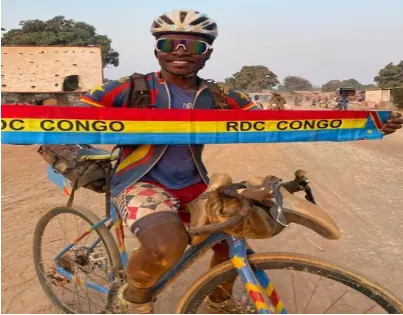
The sudden death of international cyclist Miguel Masaïsaï on September 18, 2026, in Ouesso, Republic of Congo, has sent shockwaves throughout the Democratic Republic of Congo. Masaïsaï was on a mission to promote peace and national unity through his 'Pedals for Peace' initiative, a project that aimed to cover nearly 14,000 kilometers from Goma to Rabat, Morocco. His journey was cut short when he was hit by a vehicle, but his legacy lives on.
Masaïsaï's 'Pedals for Peace' initiative was inspired by the non-violent struggle of American pastor Martin Luther King. Like King, Masaïsaï used his bicycle as a symbol of peaceful resistance, braving dangers and traversing uninhabited areas to spread his message of unity and peace. His journey was a testament to the power of individual action in promoting national cohesion.
Before his death, Masaïsaï had completed a significant portion of his journey, covering 65 days and numerous provinces in the DRC. He was warmly received at the Martyrs' Stadium in Kinshasa on August 5, 2026, where he emphasized that his initiative was not just a personal project but a symbol of hope shared by the entire Congolese population. Masaïsaï's motivations were rooted in his desire to sensitize Congolese people to the importance of consolidating peace and national cohesion.
Masaïsaï's message to the youth of the DRC was clear: peace is not just a discourse, but a reality that can be built when people from different provinces come together, hand in hand, and choose unity over division. His 'Pedals for Peace' initiative has become a beacon of hope for the Congolese people, inspiring a new generation of young people to work towards a common future.
The impact of Masaïsaï's journey extended beyond the DRC, as his message of peace and unity resonated with people across the African continent. His planned route would have taken him through several countries, including the Congo, Cameroon, Gabon, Nigeria, Ghana, Togo, Benin, Burkina Faso, Côte d'Ivoire, Senegal, Mauritania, and Morocco. Though his life was cut short, his legacy will continue to inspire young people across Africa.
As the DRC mourns the loss of Miguel Masaïsaï, there are calls for his legacy to be immortalized. The Congolese government is urged to consider declaring September 18 a national day of remembrance and to preserve Masaïsaï's effects as a memorial to his 'Pedals for Peace' initiative. His story serves as a reminder that even in death, his message of peace and unity can continue to inspire a nation.
Key points
- Miguel Masaïsaï's 'Pedals for Peace' initiative aimed to promote peace and national unity in the DRC and beyond.
- Masaïsaï's journey was inspired by the non-violent struggle of Martin Luther King.
- The Congolese government is urged to immortalize Masaïsaï's legacy and preserve his effects as a memorial.