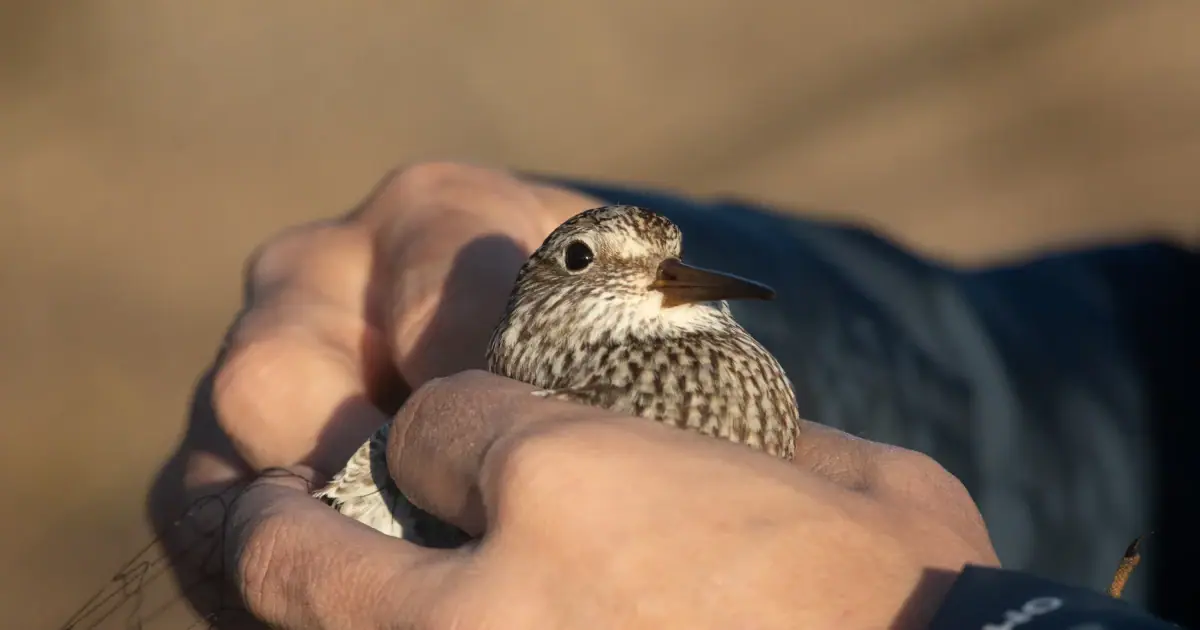
Pectoral sandpipers are remarkable birds that fly over 17,000 miles annually, crossing entire continents on their migration from Alaska to Argentina and back again. These tiny birds, weighing around three ounces, flap their wings continuously during their journey, without soaring or coasting on the wind. They are part of over 12 million shorebirds that migrate to Alaska every year to breed, spending the short summer season in open lands near water.
Scientists have been studying the migration patterns of shorebirds, including pectoral sandpipers, for years. According to Rick Lanctot, a wildlife biologist with the U.S. Fish and Wildlife Service, shorebirds are "miraculous migrants that travel these huge distances by these crazy adaptations." For 24 years, Lanctot and other researchers have tracked the return of shorebirds to northern Alaska, revealing a concerning trend: almost half of the 41 shorebird species that breed in Alaska are declining, with some losing more than half of their population over the last 30 years.
The decline of shorebirds is linked to the impact of climate change on their migration patterns. As the planet warms, the timing of their journeys is becoming increasingly disrupted. Habitats they rely on, such as wetlands and grasslands, are disappearing, and the earlier arrival of spring affects the availability of their food. Nathan Senner, who studies shorebirds at the University of Massachusetts Amherst, notes that shorebirds are "sentinels about what is happening to the planet, because they're touching down in so many of the places across that planet."
To understand the migration patterns of pectoral sandpipers, researchers are using tiny tracking tags that log the birds' locations as they fly thousands of miles. These tags have revealed that shorebirds undertake far more arduous journeys than once thought. For example, a bar-tailed godwit flew over 8,000 miles for 11 days straight without stopping from Alaska to Australia. Researchers are still figuring out how these birds navigate entire oceans and take advantage of weather patterns.
The decline of shorebirds is noticeable in communities like Utqiaġvik, where the Inupiat people have lived with them for centuries. Robin Mongoyak, a wildlife guide, remembers when sea ice lasted multiple years, but now it's becoming rare, and the ice is breaking up earlier in the spring. Temperatures in the Arctic have risen four times faster than the rest of the globe, and Mongoyak notes that "the climate is getting warmer... I don't see as many birds as I used to like seeing."
Researchers are studying how warmer temperatures affect the food of shorebirds, including insects. Julia Berliner, a graduate student at the University of Texas at Austin, is using a bug vacuum to collect samples of non-biting midges, which emerge briefly during the short Arctic summer. The thawing of permafrost due to warmer temperatures is affecting the availability of these insects, which are crucial for shorebirds' survival.
The impact of climate change on pectoral sandpipers and other shorebirds is a pressing concern. As their habitats and food sources disappear, these birds must adapt to a rapidly warming world. However, their ability to do so is uncertain, and researchers are working to understand the implications of these changes. By studying shorebirds, scientists hope to gain insights into the broader effects of climate change on the planet.
Key points
- Pectoral sandpipers migrate 17,000 miles yearly, but climate change is disrupting their journey.
- Almost half of 41 shorebird species in Alaska are declining, with some losing over half their population in 30 years.
- Climate change affects shorebirds' food sources and habitats, making it harder for them to adapt and survive.