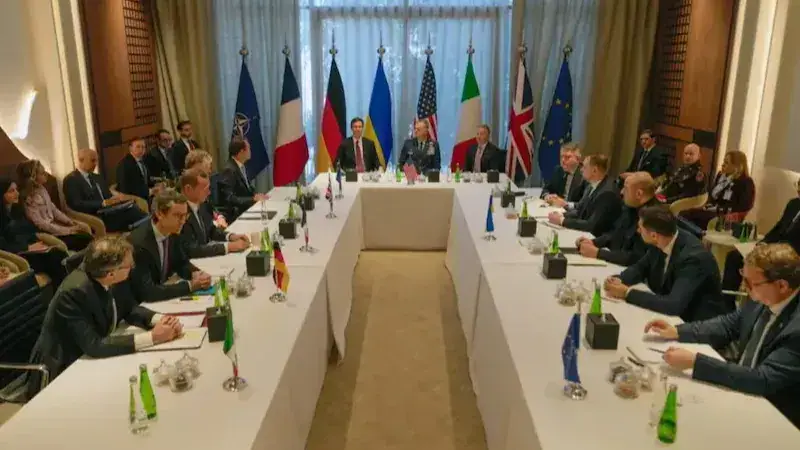
A genuine negotiation on Ukraine will require answers to three key questions. Who can commit on behalf of their government? What are the discussion points? What happens if one signatory breaches the agreement? Until then, even high-level meetings serve to probe the adversary, reassure allies, or gauge public opinion patience. The United States can potentially open a path to peace, given its direct relations with Moscow and influence on conditions for Kiev to continue fighting.
The US has interests to contain a direct confrontation with Russia, limit its engagement costs in Europe, and preserve resources for competition with China. These objectives may encourage a truce, but there is no guarantee that the desired truce aligns with what Ukrainians might accept or Europeans are willing to guarantee. Ukrainian President Volodymyr Zelensky faces a difficult decision in considering a ceasefire, as it would require explaining to citizens what happens to people in occupied territories and how cities will be protected.
A ceasefire line and a recognized border are distinct concepts. Freezing the front line without resolving sovereignty would allow Kiev to stop fighting without acknowledging Russian annexations. However, crucial questions would remain unanswered, including property rights and the right of return for families. Any agreement's provisional nature would need to be credible, accompanied by rules defining who controls the demarcation line and how to react to violations.
Russia seeks to convert its territorial control into a lasting political advantage, linking territories, Ukraine's neutrality, relations with NATO, and the configuration of Kiev's armed forces. A ceasefire must specify prohibited actions, who verifies facts, and consequences for violations. A targeted agreement on protecting energy infrastructure could test respect for limited obligations.
The European Union can support Ukraine's budget, finance reconstruction, and offer an economic integration perspective. However, military guarantees require government decisions on which countries assume obligations, for what duration, and under what circumstances. For Estonia, Latvia, and Lithuania, the war's outcome directly affects their security.
A truce that leaves Moscow convinced it can gain concessions by force would be seen as a precedent. Three possible outcomes emerge: a monitored truce, a frozen front with fragile guarantees, or continued war. The first significant diplomatic result might be less spectacular than a summit, such as a map of the agreed demarcation line or written rules on responsibilities in case of violations.
An initial diplomatic achievement could be an agreement on protecting power plants, prisoner exchange, or repatriation of remains. The path to peace requires each party to put something on the table that they are willing to give up. The United States, Russia, and Ukraine must navigate complex issues to reach a lasting agreement, with many factors, including international pressure and domestic public opinion, influencing their decisions.
Key points
- The US, Russia, and Ukraine must answer three key questions to start genuine negotiations: who can commit on behalf of their government, what are the discussion points, and what happens if one signatory breaches the agreement.