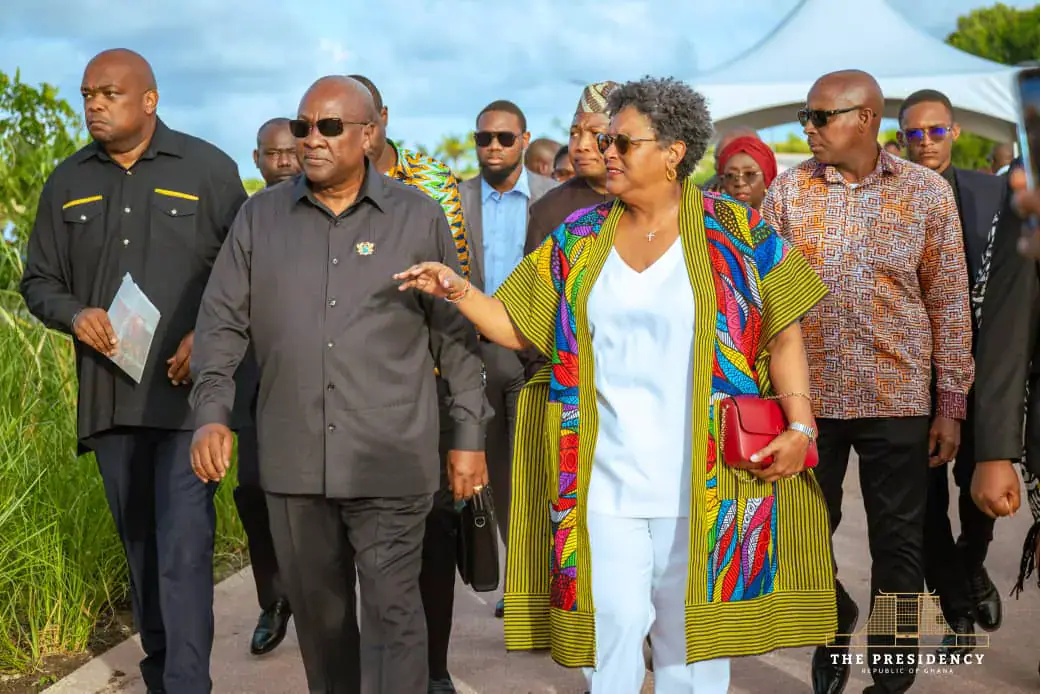
President John Dramani Mahama of Ghana and Prime Minister Mia Amor Mottley of Barbados have jointly called for renewed efforts towards reparatory justice and preservation of the history and dignity of enslaved Africans. This comes as Barbados officially opened the Ancestral Memorial to the Enslaved at Newton, honouring men, women and children buried at the historic Newton plantation burial ground. The memorial serves as a permanent place of remembrance and reflection on the human cost of slavery.
The memorial is dedicated to the estimated 570 people buried at Newton, who were treated as property under a system that separated families, extracted labour through violence and denied them dignity even in death. President Mahama noted that archaeological excavations at the site revealed evidence of starvation, torture and harsh plantation conditions, with many of those buried there not living beyond their thirties. This highlights the brutality of the transatlantic slave trade and its enduring consequences for Africa and the Caribbean.
President Mahama drew parallels between the Newton memorial and Ghana's coastal forts and castles, particularly Elmina and Cape Coast Castles. He stated that these sites, together, bore witness to the human cost of the transatlantic trade in enslaved Africans. Mahama called for an honest accounting of the history of slavery, stressing that reparatory justice must go beyond remembrance to addressing the lasting consequences of the system.
According to President Mahama, the forced labour of enslaved Africans generated wealth that benefited generations in the West, while African communities lost generations of people whose skills, talents and contributions could have shaped their development. He also called on Africans and people of African descent to defend one another against prejudice and discrimination, regardless of skin colour, birthplace, nationality or migration circumstances.
Prime Minister Mia Amor Mottley described the opening of the memorial as part of Barbados' continuing journey towards redemption, healing and the restoration of its national identity. She recognised the sacrifices of generations who endured slavery and fought against systems designed to deny them their humanity, freedom and opportunities. Mottley recalled the 1661 Slave Code, which classified Africans brought to Barbados as chattel to be sold, whipped and separated from their families.
Prime Minister Mottley highlighted education, land ownership, security of tenure and political participation as important measures through which successive generations of Barbadians had pursued self-repair. She noted that the struggle for freedom did not end with the abolition of slavery, pointing to subsequent laws and practices that continued to tie formerly enslaved people to plantations through forced labour.
The memorial aims to restore the spiritual and historical identity of the nation by ensuring that those buried at Newton were not erased from collective memory. Both President Mahama and Prime Minister Mottley emphasised the importance of reparatory justice as a continuous journey, requiring ongoing efforts to address the lasting consequences of slavery and promote healing and redemption.
Key points
- President John Dramani Mahama and Prime Minister Mia Amor Mottley called for renewed efforts towards reparatory justice at the opening of the Ancestral Memorial to the Enslaved at Newton.
- The memorial serves as a permanent place of remembrance and reflection on the human cost of slavery, honouring the estimated 570 people buried at Newton.
- Mahama and Mottley emphasised the importance of reparatory justice as a continuous journey, requiring ongoing efforts to address the lasting consequences of slavery and promote healing and redemption.