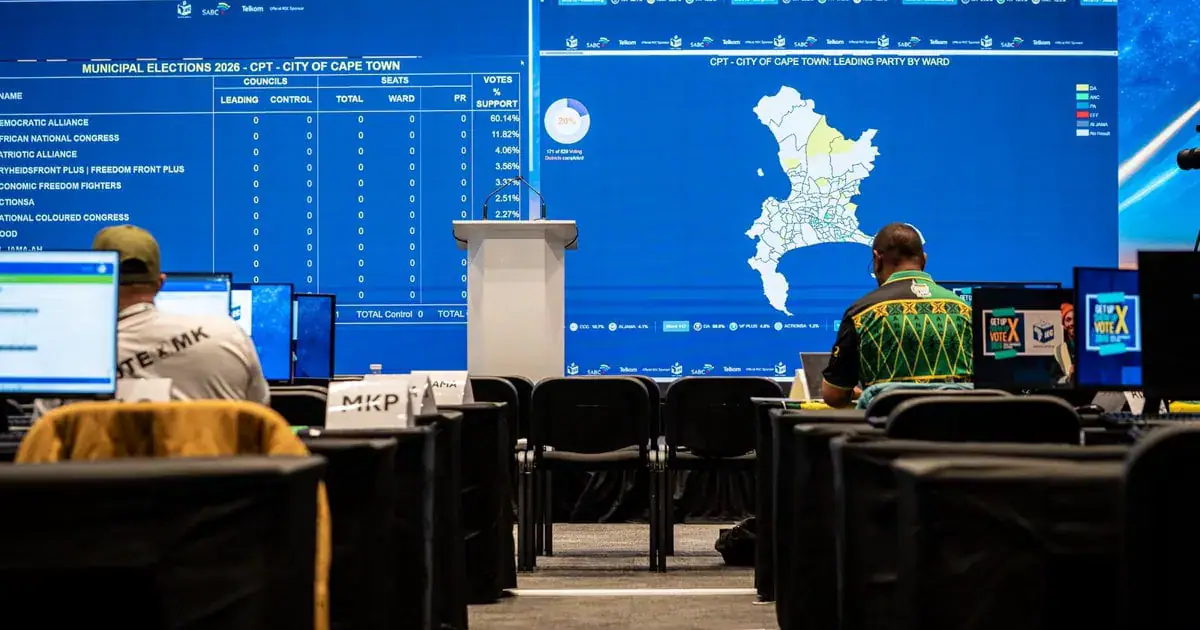
As vote-counting continues in South Africa's metropolitan municipalities, political parties are expressing cautious optimism about their chances of securing control. The process, which began on November 2, 2026, has seen various parties making strides in several notable metros. However, it remains challenging to predict the outcomes, according to local governance expert Dr. Thina Nzo. The Electoral Commission of South Africa (IEC) has set up a Results Operations Centre (ROC) at the Gallagher Convention Centre in Midrand to oversee the counting process.
The Democratic Alliance (DA) has declared victory in the City of Cape Town, extending its two-decade-long control of the metro. The party's Johannesburg mayoral hopeful, Helen Zille, expressed ambition about securing more than 40% of the vote in the metropolitan municipality. Zille aims to put together a stable coalition, having campaigned energetically and pointed out the lived realities of the poor and middle class. Her efforts have brought confidence to the City of Tshwane, the City of Johannesburg, and the City of Ekurhuleni.
ActionSA leader Herman Mashaba said the party was showing early signs of success in Gauteng, having confirmed 54 wards won in the three metros. Mashaba expressed gratitude to voters, particularly those from Soweto, Alexandra, Orange Farm, and suburban areas. He attributed the party's success to its efforts to address the failures of centuries of oppression and 32 years of ANC corruption and mismanagement. ActionSA's mayoral candidate for the City of Ekurhuleni, Xolani Khumalo, thanked voters for securing wards for the party.
The African National Congress (ANC) national spokesperson, Mahlengi Bhengu, told Eyewitness News that the party was "quietly confident and anticipating positively". Bhengu noted that the ANC had campaigned fiercely, focusing on service delivery and its challenges. However, she acknowledged that it was too early to predict the overall outcome. The IEC has received approximately 800 objections from political parties, with a deadline of 5 pm on November 5, 2026, to lodge complaints.
According to the IEC, approximately 40% of votes had been counted nationally at the time of publication. The final results of the municipal polls are scheduled to be announced on November 9, 2026. Local governance expert Dr. Thina Nzo shared her assessment of the atmosphere at the ROC, noting that Helen Zille's efforts had made the campaign exciting and energetic.
The Institute of Election Management Services' executive chairman, Terry Tselane, weighed in on the 2026 local government elections, stating that the electorate is changing and the euphoria of 1994 has dissipated. Tselane's comments highlight the evolving nature of South Africa's electoral landscape. The IEC has announced that it is making good progress with the counting of votes.
The ongoing vote-counting process and cautious optimism from various parties indicate a complex and dynamic electoral environment in South Africa's metropolitan municipalities. As the final results approach, parties are positioning themselves for potential coalition talks and negotiations. The outcome of the municipal elections will have significant implications for the country's governance and service delivery.
Key points
- The Democratic Alliance has declared victory in the City of Cape Town.
- ActionSA has confirmed 54 wards won in the three metros.
- The IEC has received approximately 800 objections from political parties.