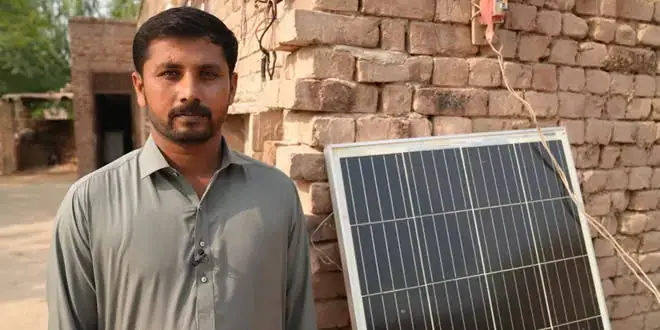
In rural Punjab, Pakistan, a young couple received a solar panel as a wedding gift, symbolizing a growing trend in the country. Faisal Shahzad, the recipient of the 340-watt panel, said it has significantly reduced his household's electricity bills and reliance on the national grid. During the summer, the panel powered his air conditioner from morning till evening, eliminating the need to draw from the grid during the day. This shift towards solar energy is gaining traction, with millions of households in Pakistan adopting similar solutions.
The rising cost of electricity and unreliable national grid have driven the adoption of solar energy in Pakistan. Electricity bills can range from 15,000 to 18,000 Pakistani rupees (approximately Rs 2600 to Rs 3100), a significant burden for households with a monthly average income of less than 40,000 rupees. To mitigate this, many households have turned to solar panels, which have become more affordable due to a decline in prices of imported Chinese panels. According to Renewables First, a Pakistani research center, the share of solar energy in the country's electricity production has increased from 1% in 2018 to 28% in 2025.
The growth of solar energy in Pakistan has been largely driven by household-level adoption, with approximately seven million households now equipped with solar panels. These panels are not only being used in homes but also in hospitals, agricultural farms, and industrial sites. Muhammad Hassan Dajana, spokesperson for Renewables First, noted that electricity tariffs have more than doubled in recent years, while the price of Chinese solar panels has decreased by 93%. This trend is expected to continue, but it also raises concerns about the financial sustainability of the national grid.
As households increasingly rely on solar energy, the national grid faces challenges in maintaining its financial viability. With reduced electricity purchases from households with solar panels, the grid must cover its fixed costs with lower revenue. If these costs are passed on to consumers through higher tariffs, it may encourage more households to adopt solar energy, creating a cycle of increasing costs for those who cannot afford to invest in solar panels. This raises concerns about who will bear the cost of maintaining the grid.
Pakistan's Minister of Energy, Awais Ahmad Leghari, aims to make the national grid more competitive by offering better tariffs and renegotiating contracts with private producers. He also plans to improve energy storage and reduce losses. For households like Faisal Shahzad's, the national grid remains essential during periods of low solar energy production. The challenge lies in maintaining a reliable and affordable energy supply for all households.
The shift towards solar energy in Pakistan has significant economic implications. The reduced demand for electricity from the national grid has resulted in an estimated loss of over $500 million per year for the past two years. However, the government remains committed to increasing the share of renewable energy in the country's energy mix. By 2036, the target is to generate up to 90% of electricity from clean sources, including solar and nuclear energy.
As Pakistan continues to transition towards renewable energy, the government faces the challenge of balancing the needs of households and industries with the financial sustainability of the national grid. With a goal to reduce the country's dependence on imported energy from 26% to 4%, the government must navigate the complexities of the energy sector to ensure a reliable and affordable energy supply for all.
Key points
- Seven million households in Pakistan have adopted solar panels to reduce their reliance on the national grid.
- The share of solar energy in Pakistan's electricity production has increased from 1% in 2018 to 28% in 2025.
- The Pakistani government aims to generate up to 90% of electricity from clean sources by 2036.