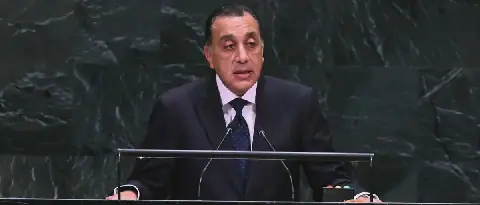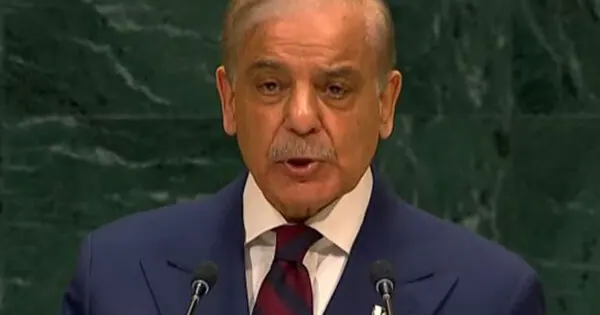
Pakistan Prime Minister Shehbaz Sharif is under immense pressure at home due to a failing economy, opposition protests, and conflicts in provinces. This domestic pressure led Sharif to resort to familiar rhetoric during his speech at the UN General Assembly. He revisited old issues, including the Indus Waters Treaty and Kashmir, in an attempt to rally international support. Sharif's address was marked by claims of Pakistani victories and accusations against India.
Sharif claimed that Pakistan had successfully navigated a conflict with India in May 2025, crediting US President Donald Trump for his "timely intervention." However, India has consistently maintained that the ceasefire was achieved through direct communication between the two countries, with no third-party involvement. Trump's claims of intervention have been disputed, and an Indian diplomat was seen reacting with skepticism during Sharif's speech.
The conflict in question arose after India launched Operation Sindoor on May 7, 2025, targeting terrorist infrastructure in Pakistan and Pakistan-occupied Kashmir. This operation was a response to the April 22 Pahalgam terror attack that killed 26 civilians. India views the operation as a demonstration of its military and strategic power, aimed at neutralizing terrorist threats and enforcing its zero-tolerance policy towards terrorism.
Sharif also addressed the Indus Waters Treaty, signed between India and Pakistan in 1960. He claimed that India's decision to hold the treaty in abeyance had no legal basis and that the Indus River system was vital for Pakistan's survival. Sharif warned that any attempt to stop, impede, or divert Pakistan's share of the waters would be treated as an act of war. India placed the treaty in abeyance following the Pahalgam terror attack, citing Pakistan's support for terrorism.
The Kashmir issue was another key topic in Sharif's speech. He called for a "just and fair solution" to the Kashmir dispute, claiming that the Kashmiri people have endured decades of "illegal occupation, arbitrary detention, extrajudicial killings, enforced disappearance, sexual violence, and collective punishment." India has repeatedly rejected Pakistan's references to Jammu and Kashmir at the UN General Assembly, maintaining that the Union Territory is an integral part of India.
Sharif's speech was seen as an attempt to internationalize the Kashmir issue and divert attention from domestic problems. His remarks were met with skepticism by Indian diplomats and observers, who view Pakistan's stance on Kashmir as an attempt to legitimize its claims. The international community has been cautious in its response to Sharif's claims, with many countries emphasizing the need for direct communication and diplomacy between India and Pakistan.
The challenges facing Sharif's government are multifaceted, with a struggling economy, opposition protests, and security concerns. His resort to familiar rhetoric on India and Kashmir may be seen as an attempt to rally domestic support and create a sense of national unity. However, the international community remains skeptical of Pakistan's claims, and Sharif's speech is unlikely to change the status quo on these issues.
Key points
- Pakistan PM Shehbaz Sharif faces domestic pressure due to a failing economy and opposition protests.
- Sharif resorted to familiar rhetoric on the Indus Waters Treaty and Kashmir during his UN General Assembly speech.
- India's stance on Kashmir and the Indus Waters Treaty remains unchanged, with New Delhi viewing Pakistan's claims as an attempt to legitimize its own territorial ambitions.