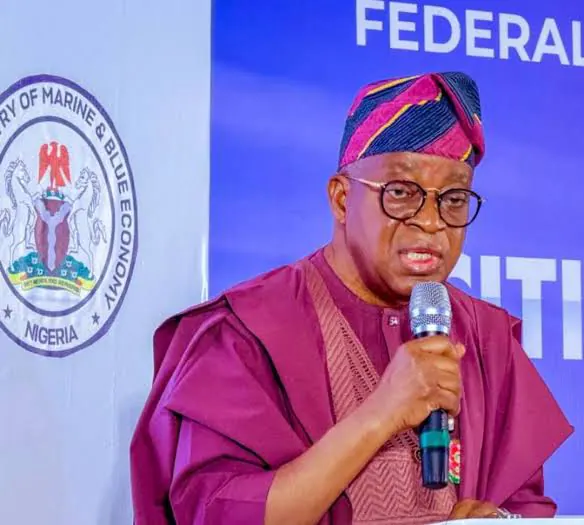
Nigeria's Minister of Marine and Blue Economy, Adegboyega Oyetola, has highlighted the country's recent inclusion in Category C of the International Maritime Organization (IMO) Council as a significant achievement. This development had eluded Nigeria for 15 years. Oyetola made these remarks during his 72nd birthday celebration in his hometown of Iragbiji, Osun State. He expressed gratitude to President Bola Ahmed Tinubu for establishing a dedicated ministry to harness Nigeria's untapped aquatic resources.
Oyetola emphasized that Nigeria is endowed with substantial marine assets, including 853 kilometres of coastline, 10,000 kilometres of inland waterways, and an extensive Exclusive Economic Zone. These assets, he noted, remain underutilized. The ministry's creation aims to tap into these resources to generate employment, drive economic growth, and ensure environmental sustainability. A robust National Policy on Marine and Blue Economy has been approved by the Federal Executive Council to guide investment opportunities.
The Minister highlighted improvements in maritime security and global standing, citing Nigeria's election into Category C of the IMO Council. This milestone had repeatedly eluded the nation. Oyetola also revealed that capacity-building initiatives for local fishermen have increased annual domestic fish yield from 1.3 million to 1.5 million metric tons, reducing reliance on seafood imports. These initiatives have contributed to the growth of the marine sector.
To enhance safety across inland waterways, the ministry is taking measures to address unseaworthy vessels and overloading. Mass public advocacy and distribution of life jackets to operators are underway to minimise boat mishaps. Oyetola emphasized the importance of these efforts in ensuring the safety of lives and preventing accidents on inland waterways.
The Minister outlined ongoing efforts to modernize Nigeria's existing seaports in Apapa, Tin Can Island, Warri, Calabar, and Port Harcourt. He noted that shallow draft levels result in significant revenue losses to neighbouring coastal countries. The ports currently average a draft depth of about 13 metres, but attracting modern mega-vessels requires 16 to 18 metres. Dredging and upgrading facilities to reach a minimum 16-metre depth are underway.
Plans are underway to expand deep-sea port capacity beyond the Lekki Deep Sea Port. A recent memorandum of understanding was signed between the Ogun State Government and global port operator DP World to construct a deep-sea port featuring an 18-metre draft depth. These infrastructure developments aim to drastically reduce vessel turnaround times, boost trade efficiency, and maximise maritime revenue.
During the event, Alhaji Bola Oyebamiji, the governorship candidate of the All Progressives Congress (APC) in Osun State, paid tribute to Oyetola, describing him as a compassionate leader and mentor. Oyebamiji noted that Oyetola's service continues to uplift party members and the wider public. The Minister's efforts have been recognized as contributing to the growth and development of the marine sector.
Key points
- Nigeria's inclusion in Category C of the IMO Council after 15 years.
- Upgrade plans for ports in Apapa, Tin Can Island, Warri, Calabar, and Port Harcourt.
- Annual domestic fish yield increases from 1.3 million to 1.5 million metric tons.