More than 280,000 Palestinian children have resumed classes in makeshift settings, including tents and heavily damaged buildings, in Gaza. The United Nations Relief and Works Agency for Palestine Refugees (UNRWA) is operating these temporary classes. This effort aims to restart education for children after nearly three years of severe disruption due to the conflict.
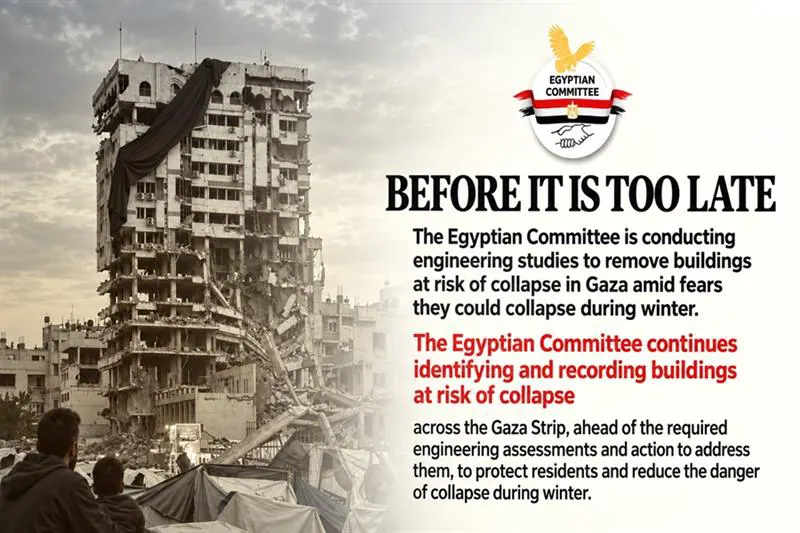
An Egyptian relief body, the Egyptian Relief Committee in the Gaza Strip, is conducting a survey to identify and record buildings at risk of collapse across Gaza. This initiative is crucial for protecting residents, especially with winter approaching, when rain and strong winds could further weaken structures damaged by Israeli bombardment. The committee's work will pave the way for engineering assessments to determine how to make these structures safe.
The Egyptian Relief Committee has been actively involved in providing relief inside Gaza, including clearing roads and rubble, operating camps, drilling water wells, and supporting educational and humanitarian activities. Their efforts are critical in addressing the immediate needs of the affected population. Recently, a damaged building in Gaza City's Tal Al-Hawa area collapsed, resulting in 21 deaths and 45 survivors.
Gaza's civil defence agency has identified around 2,000 buildings at risk of collapse in the strip. However, Alessandro Mrakic, head of the United Nations Development Programme's (UNDP) Gaza office, estimates that approximately 400 buildings face a high risk of collapse, particularly with winter approaching. Palestinian rescue officials face challenges due to shortages of excavators, cranes, and other heavy machinery.
Israel's restrictions on equipment entering Gaza are intended to prevent machinery from being used by armed groups, but humanitarian agencies argue that these controls obstruct rescue, structural-safety, and debris-removal work. Handling damaged buildings requires careful documentation to avoid disturbing human remains or erasing evidence relevant to investigations into alleged crimes.
The return to education is closely linked to Gaza's shelter and reconstruction crisis. Many functioning school buildings continue to house displaced families, while children living in unsafe structures or distant camps struggle to reach temporary learning centres. UNICEF estimates that around 700,000 children aged four to 17 missed formal, in-person education for nearly three academic years.
Egypt continues to provide humanitarian assistance, including food, medical supplies, and fuel, through the Egyptian Red Crescent. The country has dispatched 280 humanitarian convoys, with the most recent one, on 17 September, carrying 4,373 tonnes of assistance. Large-scale fighting eased following the October 2025 ceasefire, but Israeli strikes have continued, resulting in at least 1,390 Palestinian deaths in the past 11 months.
Key points
- Over 280,000 Palestinian children attend makeshift UNRWA classes in Gaza.
- Egyptian relief body assesses buildings at risk of collapse in Gaza.
- Gaza's education system faces significant challenges due to the ongoing conflict and reconstruction crisis.