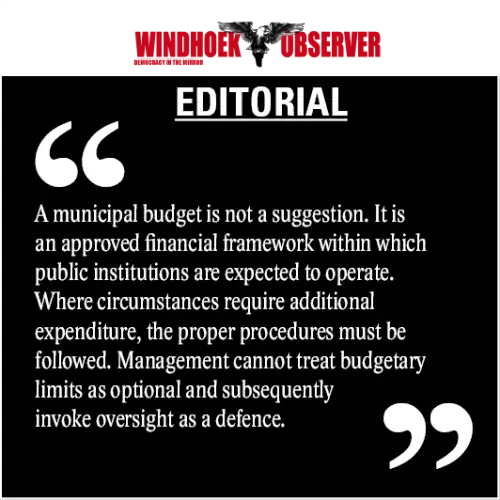
The Otjiwarongo Municipality in Namibia is confronting a worrying breakdown in financial discipline, management accountability, and institutional oversight, according to the Ministry of Finance's internal audit report. The report suggests that the town's financial issues run deeper than administrative inefficiency. The findings indicate a serious failure of financial planning and expenditure control, with expenditure running substantially beyond approved budgets and inadequate evidence of necessary authorizations.
The recruitment of four strategic executives by the municipality cost approximately N$394,000, which was outsourced to a company despite the human resources department being equipped to manage the process. The initial quotations totaled N$269,000, but the eventual expenditure rose substantially. One of the four positions remained vacant, requiring the recruitment process to be repeated. The appointed recruitment company allegedly failed to submit mandatory compliance documents, which management attributed to an oversight.
The audit report reveals that legal fees reached N$1.22 million against an allocation of N$450,000, while telephone expenses exceeded their N$250,000 budget by more than 200%. Copier and fax rentals amounted to N$301,444 against an allocation of N$32,000, an extraordinary overspend of approximately 842%. These discrepancies represent serious failures of financial planning and expenditure control.
The municipality's management appears unable to account for its own financial position, with revenue reaching only 71.2% of projections. Proceeds from the sale of erven amounted to just 15.3% of the target, and government subsidies also fell substantially below expectations. Cash reserves declined from N$81 million to approximately N$20.5 million, a reduction of about 75%. Consumer debtors stood at N$68.8 million, with N$54.3 million outstanding for more than 150 days.
The situation is compounded by approximately N$5.9 million in unsupported revenue adjustments, an unreconciled suspense account of N$1.71 million, and weaknesses in payment verification. Auditors also found instances where suppliers were paid without adequate certification that goods had been received or services satisfactorily completed. These circumstances can allow financial irregularities to flourish.
The municipality's capital expenditure performance is equally concerning, with only 29.8% of the approved capital budget spent. Major projects, including the Emergency Response Unit and sewer line construction, recorded no expenditure. This contradiction at the heart of Otjiwarongo's predicament sees money being overspent on administrative and operational items while essential development projects remain unimplemented.
A reported cyber incident adds another dimension to the municipality's challenges. The municipality appears unable to provide auditors with sufficient evidence of the extent of the breach, its financial implications, or the measures taken to secure affected systems. Management must be given an opportunity to respond fully and demonstrate that corrective measures are being implemented.
Key points
- The Ministry of Finance's internal audit report reveals a worrying breakdown in financial discipline, management accountability, and institutional oversight in the Otjiwarongo Municipality.
- The municipality's management appears unable to account for its own financial position, with significant shortfalls in revenue and substantial overspending in various areas.
- The situation demands answers, consequences, and decisive corrective action to address the serious failures of financial planning and expenditure control.