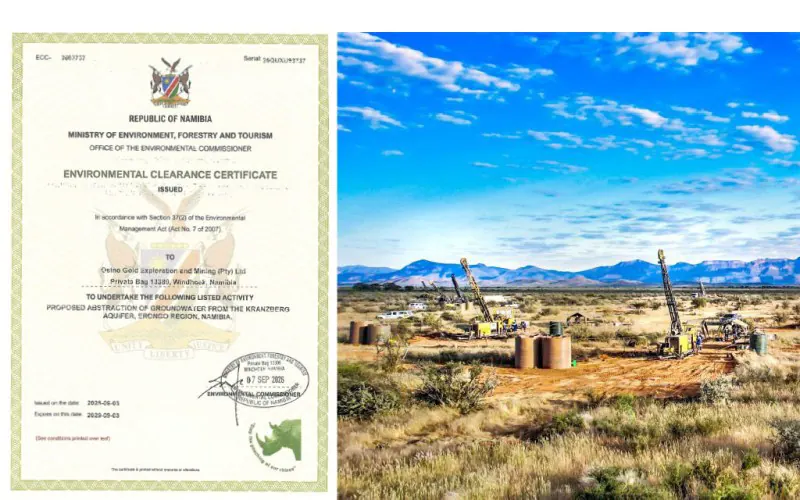
Osino Gold Exploration and Mining (Pty) Ltd has obtained environmental clearance to abstract groundwater from the Kranzberg Aquifer in Usakos, Namibia. The clearance, granted by the ministry of environment, forestry and tourism's directorate of environmental affairs on 3 September, allows the company to use the groundwater as a water supply option for its Twin Hills Mine in the Erongo Region. This approval was granted under the Environmental Management Act of 2007 and the Environmental Impact Assessment Regulations of 2012.
The proposed groundwater abstraction is part of Osino's water supply strategy for the Twin Hills Mine, which is currently under development in the Erongo Region. According to SLR Environmental Consulting, the decision followed an environmental impact assessment process for the proposed abstraction of groundwater from the Kranzberg Aquifer. The clearance is subject to the provisions of the Environmental Management Act and applicable environmental regulations. The notice also provides for an appeal against the Environmental Commissioner's decision.
The Twin Hills Mine is expected to require approximately 3,300 cubic meters of water per day, or around 1.1 million cubic meters annually, based on an initial throughput of 5 million tonnes per year. Osino has a licensed groundwater abstraction allocation of 0.75 million cubic meters per year from the Karibib Marble Aquifer. Due to water scarcity and climate variability in central Namibia, the company is pursuing a diversified water supply strategy. Additional sources being considered include pit dewatering, tailings filtration, and wastewater reuse.
As part of its water strategy, Osino is also proposing a Sand Storage Dam (SSD) that could provide between 30% and 40% of the mine's water demand. The SSD is expected to have around 7.4 million cubic meters of seasonal flow through the Spes Bona compartment. Furthermore, the assessment proposes managed aquifer recharge, whereby captured water could be injected into the Karibib Marble Aquifer to reduce evaporation losses and enhance groundwater recharge. This strategy aims to strengthen long-term supply security for the planned mine life.
The Twin Hills gold project, located near Karibib, is targeting first gold production before the end of 2027. The project is expected to have a life of more than ten years, with an annual production profile averaging close to 170,000 ounces once the operation reaches steady state. Osino was acquired by Shanjin International Gold for N$4.8 billion two years ago. Shanjin stated that the Twin Hills gold mine project is expected to increase gold production capacity by five tons per year upon commencement of production.
The Environmental Clearance Certificate (ECC 2603737) was issued by SLR Environmental Consulting on behalf of Osino. The certificate is a critical step towards ensuring that the company's water supply strategy is environmentally sustainable. The clearance is also subject to an appeal process, where persons aggrieved by the decision may appeal within 14 days from receipt of the notification, using the prescribed Ministry form and accompanied by the required fee.
Osino's water strategy is designed to mitigate the risks associated with water scarcity and climate variability in central Namibia. By diversifying its water supply sources, the company aims to ensure a secure and sustainable water supply for the Twin Hills Mine. The implementation of the water strategy will be closely monitored to ensure that it meets the required environmental standards and regulations.
Key points
- Osino receives environmental clearance for groundwater abstraction from Kranzberg Aquifer for Twin Hills Mine.
- The Twin Hills Mine is expected to require approximately 3,300 cubic meters of water per day.
- The mine is targeting first gold production before the end of 2027 with an annual production profile of close to 170,000 ounces.