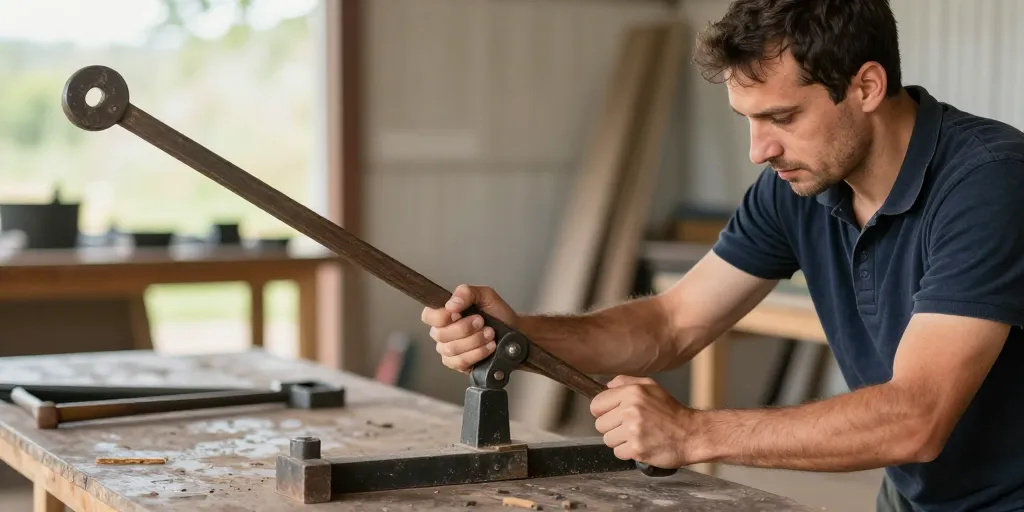
In Algeria, manual labor is often required for moving heavy objects, which can lead to injuries and strain on the musculoskeletal system. However, by applying the principle of levers, individuals can significantly reduce the effort needed to lift and move heavy loads. A lever is a simple machine that consists of a rigid bar, a fulcrum, and a force applied to move a load. By positioning the fulcrum correctly, individuals can amplify their force and lift heavier objects with less effort.
The mechanical advantage of a lever depends on the position of the fulcrum, the force applied, and the distance from the fulcrum to the load. According to the Centre canadien d'hygiène et de sécurité au travail (CCHST), using a lever can reduce the muscular effort required to move a heavy load, provided that certain positioning guidelines are followed. In Algeria, professionals and non-professionals alike can benefit from understanding the principles of levers to optimize their lifting techniques and prevent injuries.
There are three types of levers, classified according to the position of the fulcrum. The first type of lever has the fulcrum situated between the force and the load, similar to a balance or a pair of pliers. An example of this type of lever is a crowbar used to pull out nails, where the fulcrum rests on the support, and the force is applied on one side, while the resistance is on the other. Understanding the different types of levers can help Algerians choose the most effective technique for a specific lifting task.
The second type of lever has the load situated between the fulcrum and the force, as seen in a wheelbarrow. This type of lever is commonly used in everyday tasks, such as gardening or construction. By positioning the load close to the fulcrum and applying a force at a distance, individuals can easily lift and move heavy loads. In Algeria, workers in various industries can benefit from using wheelbarrows and other tools that utilize the second type of lever.
A common mistake made by many people when lifting heavy objects is to position the fulcrum too far from the load and too close to the hand. This can negate the mechanical advantage of the lever and lead to unnecessary strain on the muscles and joints. To avoid this mistake, it is essential to keep the lever arm on the load side as short as possible, while extending the lever arm on the force side as much as the context allows.
The calculation of the lifting force shows that a poorly positioned load of 50 kg can generate a greater rotational torque than a correctly applied load of 10 kg with a long lever arm. In Algeria, where manual labor is common, it is crucial to understand the importance of proper technique when lifting heavy objects. By applying the principles of levers and taking the time to position the fulcrum and load correctly, individuals can reduce the risk of injury and make heavy lifting tasks more manageable.
Algerians can benefit from leveraging techniques to improve their lifting capabilities and prevent injuries. By understanding the principles of levers and applying them in everyday tasks, individuals can reduce muscle strain and make heavy lifting tasks more efficient. Additionally, professionals in various industries can optimize their lifting techniques to improve productivity and reduce the risk of work-related injuries.
Key points
- Using a lever can reduce the muscular effort required to move a heavy load.
- There are three types of levers, classified according to the position of the fulcrum.
- Proper technique when lifting heavy objects is crucial to prevent injuries and reduce muscle strain.