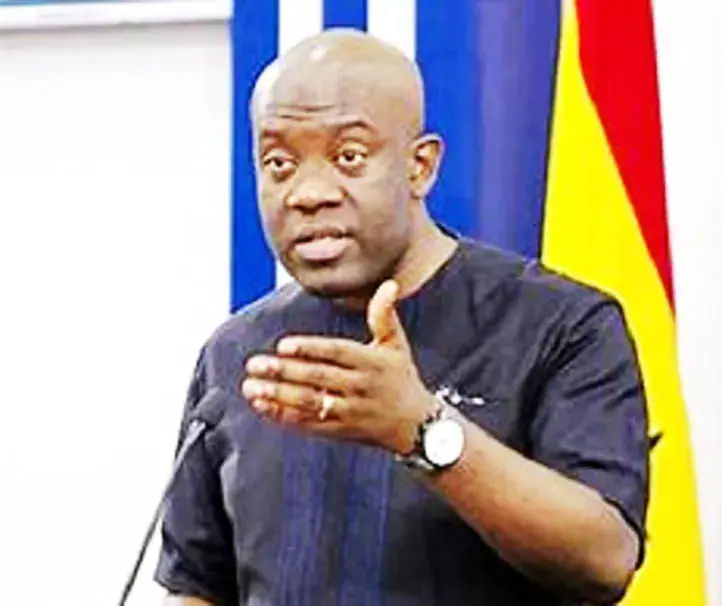
The Ranking Member of Parliament’s Economy and Development Committee, Kojo Oppong Nkrumah, has expressed concerns about the Bank of Ghana’s aggressive inflation-control measures. He argues that monetary policy must balance controlling inflation and sustaining economic activity. During an engagement with Bank of Ghana officials, Mr Oppong Nkrumah raised concerns about the Central Bank’s inflation-targeting framework and its implications for businesses, employment, and living conditions in Ghana.
The Bank of Ghana has an inflation target of 8 per cent, with a margin of plus or minus two percentage points, making the acceptable range 6 to 10 per cent. Mr Oppong Nkrumah questioned pursuing inflation levels below the lower boundary of the target range, especially after the October 2026 rate fell to 5.5 per cent. He asked if maintaining inflation below six per cent could reflect an overly restrictive monetary policy stance, given high operating costs and economic pressures on businesses and households.
A Bank of Ghana official responded that the Central Bank’s projections indicated inflation would return to the target band within the forecast period. The official attributed low inflation readings to base effects from elevated inflation levels in the previous year. According to the official, the Monetary Policy Committee must remain cautious about emerging risks and ensure decisions support a gradual and stable movement of inflation towards the target.
Mr Oppong Nkrumah cited the International Monetary Fund’s review, indicating that much of Ghana’s inflationary pressure was cost-driven. He questioned the Bank’s reliance on demand-management measures, which may not address underlying causes of rising prices. He argued that measures aimed at controlling demand may not adequately address difficulties facing businesses and households when inflation is driven by production costs, utility charges, rent, and other supply-side pressures.
Mr Oppong Nkrumah sought to establish whether the Central Bank was engaging the government and advising relevant institutions on measures to tackle cost-related pressures. He cited rising services inflation, rent, and electricity costs, which continued to burden households and businesses despite declining headline inflation. A Bank of Ghana official maintained that monetary policy decisions were guided by economic data and the Central Bank’s primary mandate was to manage demand rather than directly address supply-side cost pressures.
The Bank of Ghana official disclosed that the Monetary Policy Committee had reduced the policy rate from 28 per cent to 14 per cent, stressing that decisions were guided by balancing price stability with economic growth. The Bank maintained that its inflation-targeting framework considers both price stability and economic growth, and the committee remained conscious of the potential impact of its decisions on the real sector.
Mr Oppong Nkrumah also questioned the disparity between the national headline inflation rate and regional and sectoral figures. He observed that while headline inflation stood at 5.5 per cent, inflation in the Ashanti Region was approximately 9.8 per cent, and services inflation was about 8.3 per cent. He argued that these variations explained why many Ghanaians continued to experience significant cost-of-living pressures despite the reported decline in overall inflation.
Key points
- Kojo Oppong Nkrumah questions the Bank of Ghana's inflation control measures and their impact on economic growth and employment.
Reporting sources
- Oppong Nkrumah Questions BoG’s Inflation Strategy · The Ghanaian Chronicle