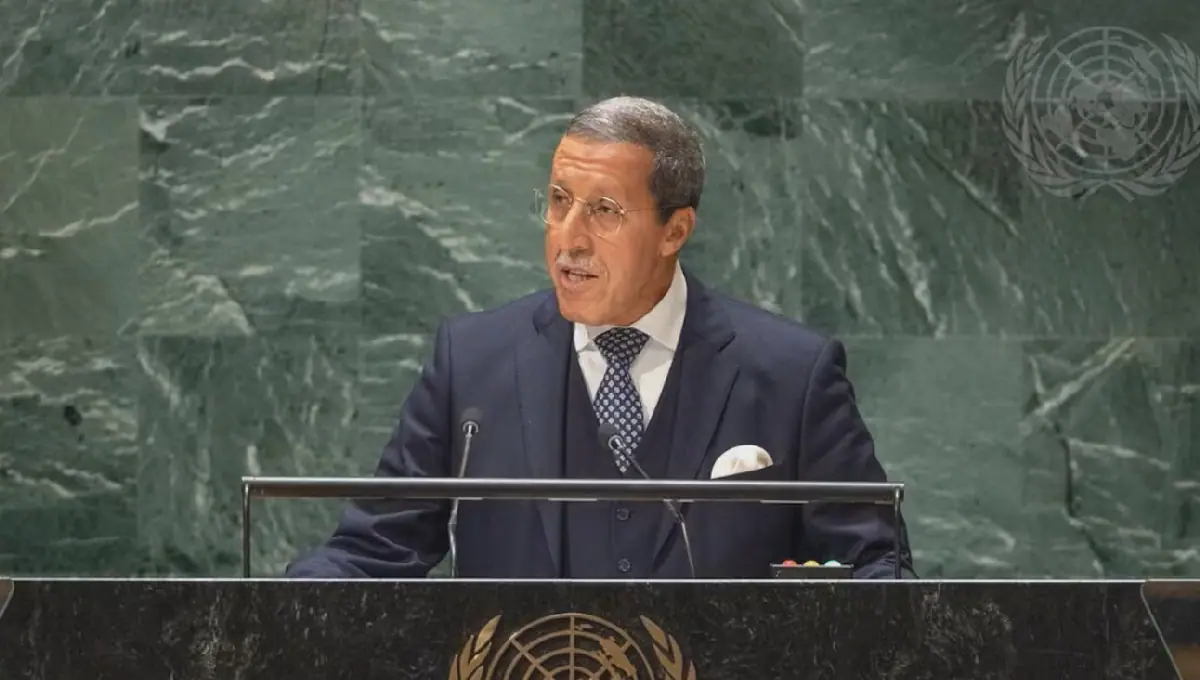
Moroccan Ambassador to the United Nations Omar Hilale addressed the UN General Assembly, stating that the Sahara region will remain under Moroccan sovereignty "until the end of time." He made these remarks during a plenary session discussing Russia's veto of a US resolution to renew the mandate of the UN Mission for the Referendum in Western Sahara (MINURSO). Hilale emphasized that the veto was not the cause of the dispute but rather a consequence of the complex situation.
Hilale posed six questions to clarify Algeria's stance on the Sahara dispute, highlighting the country's role in perpetuating the conflict. He asked why Algeria fears the autonomy plan under Moroccan sovereignty, which has been presented as the sole basis for resolving the dispute. The ambassador noted that autonomy and self-determination share a common root, with autonomy being self-determination in action. He also questioned Algeria's refusal to assume its status as a party to the conflict.
Hilale criticized Algeria's actions, stating that the country is not an observer but an orchestrator of the conflict. He pointed out that Algeria provides support to the Polisario Front, including camps in Tindouf, arms, financial resources, and diplomatic backing. The ambassador argued that when the Polisario Front says no, it is Algeria's voice that is being heard. He also questioned Algeria's attachment to the "R" in MINURSO's mandate, which refers to the referendum.
The Moroccan ambassador addressed Algeria's opposition to registering the population of Tindouf camps, stating that counting the population would require accountability for aid diversion and human rights violations. He also criticized Algeria's rejection of durable solutions, suggesting that the country fears the evaporation of the Tindouf camps with the departure of refugees. Hilale emphasized that the situation in Tindouf has become a diplomatic trade.
Hilale discussed the humanitarian crisis in Tindouf, where four generations have been born and live as refugees. He described the situation as a "drama" that has lasted for half a century, with Algeria assuming political responsibility. The ambassador also questioned Algeria's fear of expanding consultations by the UN Personal Envoy to the Sahrawi populations in the southern provinces, the diaspora, and those in Tindouf camps.
The Moroccan ambassador summarized the situation, stating that the veto may end a mandate but will not change Morocco's history or sovereignty over the Sahara. He emphasized that the autonomy plan under Moroccan sovereignty remains the sole solution to the dispute. Hilale contrasted Morocco's engagement with Algeria's evasion, stating that the blockade is not in Rabat or New York but in Algiers, which has refused all solutions.
Hilale concluded his address by reiterating that the Sahara dispute will not be resolved by ignoring the facts or the parties involved. He emphasized that Morocco has fulfilled its commitments, while Algeria has refused to engage in the peace process. The ambassador's address aimed to shed light on Algeria's responsibility in perpetuating the conflict and to emphasize Morocco's commitment to finding a solution based on autonomy under Moroccan sovereignty.
Key points
- Morocco's sovereignty over the Sahara region will remain unchanged despite the ongoing dispute.
- Algeria's role in perpetuating the conflict has been criticized by Moroccan Ambassador Omar Hilale.
- The autonomy plan under Moroccan sovereignty remains the sole solution to the Sahara dispute.