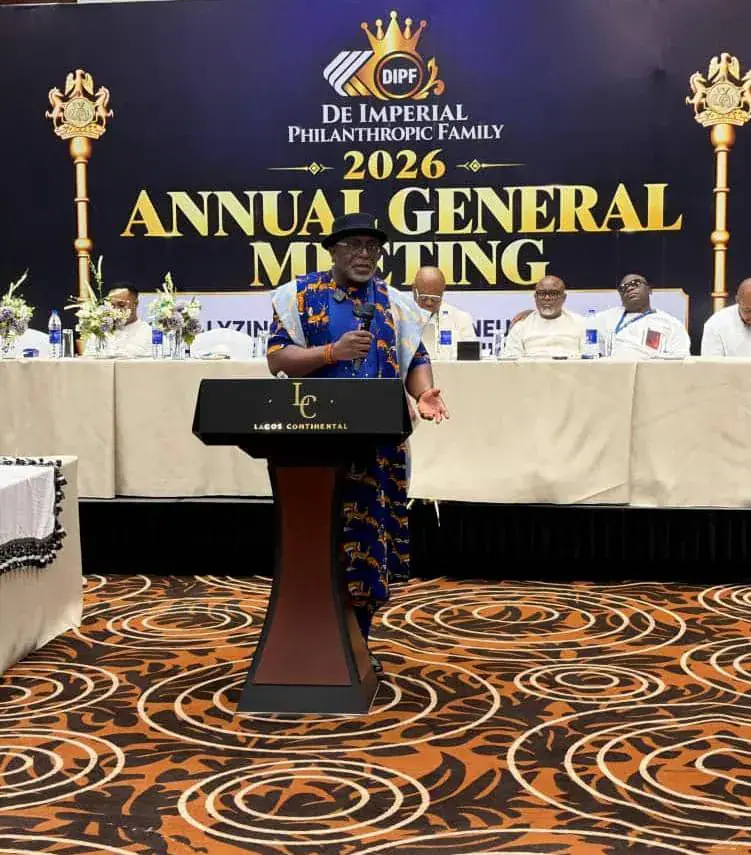
Professor Obiora Okonkwo, Executive Chairman of United Nigeria Airlines, has urged Igbo business owners to reform their traditional entrepreneurial model to remain competitive in the emerging global economy. He made the call while delivering a presentation at the 2026 Annual General Meeting of De Imperial Philanthropic Family in Lagos. Okonkwo emphasized that the traditional Igbo business model, built around individual initiative, self-reliance, apprenticeship, and commercial enterprise, remains valuable but requires strategic adjustments.
Okonkwo identified areas where Igbo businesses need to evolve to respond to changing economic realities, technological advancements, and increasing international competition. He stressed that the Igbo apprenticeship system, which has historically played a significant role in developing entrepreneurs, transferring business knowledge, and creating opportunities for young people, requires urgent attention. The apprenticeship model should be retained but expanded to equip participants with the competencies required to operate successfully in today’s technology-driven business environment.
Okonkwo proposed integrating digital commerce, financial technology, data analytics, artificial intelligence, international marketing, business management, intellectual property, and export procedures into the traditional apprenticeship structure. This would prepare apprentices not only to establish businesses but also to manage, expand, and position them for international opportunities. He emphasized that the practical, mentor-based character of the apprenticeship system should remain intact, as its ability to transfer real-life business experience is one of its greatest strengths.
Okonkwo also called for stronger collaboration between universities and the private sector, criticizing academic institutions that conduct research without adequately considering how their findings can be commercialized or translated into economic value. He advocated closer relationships between universities and businesses to ensure that research outputs address practical industrial challenges, while knowledge and experience from the informal business sector enrich academic activities.
The United Nigeria Airlines chairman urged established enterprises to create opportunities for young people to contribute ideas, experiment with new approaches, and participate in business development. He emphasized that indigenous businesses must develop a culture of continuous learning and innovation rather than remain comfortable with traditional methods that may no longer be sufficient to compete in an increasingly sophisticated global marketplace.
Okonkwo highlighted the need for Igbo entrepreneurs to move away from unhealthy competition and rivalry towards strategic partnerships and shared business interests. He cited the relationship between United Nigeria Airlines and Air Peace as an example of how businesses can work together despite operating in the same industry. This partnership demonstrates that businesses can achieve more through cooperation than through unnecessary rivalry.
Okonkwo also devoted considerable attention to the export readiness of Nigerian businesses, stressing that the ability to produce goods is not enough to guarantee access to international markets. He recounted his experience while studying in Russia, where he was able to import products from several countries but could not source Nigerian products because they did not meet the required export standards. This experience exposed the challenges confronting Nigerian manufacturers and entrepreneurs.
Key points
- Okonkwo urges Igbo businesses to adopt collaboration and technological innovation to remain competitive globally.
- The traditional Igbo apprenticeship system needs to be expanded to equip participants with competencies required to operate in today’s technology-driven business environment.
- Igbo entrepreneurs must move away from unhealthy competition and rivalry towards strategic partnerships and shared business interests.