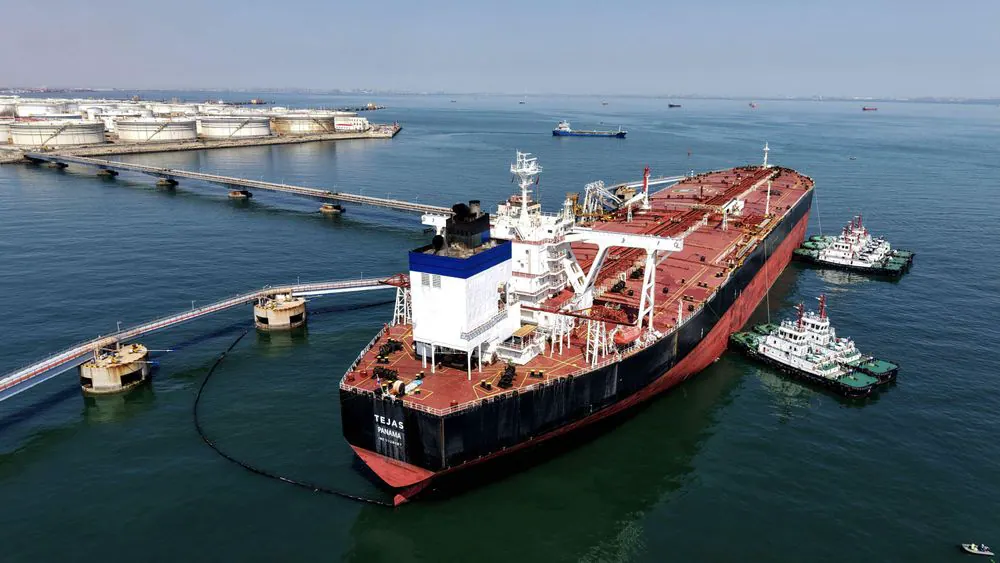
Oil prices experienced a decline on Wednesday following an announcement by US President Donald Trump that talks between the United States and Iran had been "very good". The international benchmark, Brent crude, and the main US contract, West Texas Intermediate, fell to $98.91 and $89.93 per barrel respectively in early Asian trade. This drop comes after a series of escalating tensions in the Middle East, which had previously driven oil prices above the $100 mark.
The three-hour meeting between US and Iranian representatives was described by Trump as "very productive", with both sides scheduled to meet again in the near future. This development marks a shift in the market from pure escalation pricing toward a genuine diplomatic process. According to Stephen Innes at Quintex Intel, while a final deal still appears distant, the talks signal a move towards diplomacy.
The ongoing conflict in the Middle East has led to a complex situation, with Iran maintaining a blockade of the Strait of Hormuz and the United States imposing a counter-blockade on Iranian ports. A parallel conflict between Saudi-backed government forces and the Iran-backed Houthis in Yemen has also affected energy exports from the Red Sea. These tensions have contributed to the volatility in oil prices.
In response to the developments, Saudi Arabia reportedly restarted operations along its East-West Pipeline, a crucial oil export route that had been shut down due to the conflict. The kingdom aims to resume exports later in the week. However, while Saudi oil giant Aramco informed Asian refiners that they could soon pick up crude from the Red Sea port of Yanbu, European counterparts were told they would not be allocated oil in October.
The impact of the US-Iran talks on oil prices and the broader market was a key focus on Wednesday. Asian markets were mixed, with Taiwan's Taiex index rising 0.8 percent following a renewed burst of confidence in artificial intelligence. The release of new, cheaper AI models by Anthropic and OpenAI contributed to this trend. Traders were also looking ahead to a summit between Trump and China's President Xi Jinping, expected to focus on trade between the world's two biggest economies.
The simmering US-China trade war remains a key concern, with both sides maintaining a tariff truce for nearly a year but yet to secure a lasting agreement. Analysts believe that the higher impact issue will be the war in the Middle East and any support the US can extract from China to use its leverage to sway the Iranians. The evolving AI arms race between the two economic and strategic competitors is another high-powered issue.
At around 4:15 (SA time), West Texas Intermediate was down 0.7 percent at $89.93 per barrel, while Brent North Sea Crude was down 0.3 percent at $98.91 per barrel. The market continues to monitor the situation in the Middle East and the implications for oil prices and global trade.
Key points
- Oil prices fell after US President Donald Trump's announcement of "very good" talks with Iran.
- The talks signal a shift towards diplomacy, but a final deal still appears distant.
- The ongoing conflict in the Middle East and US-China trade tensions continue to impact the market.