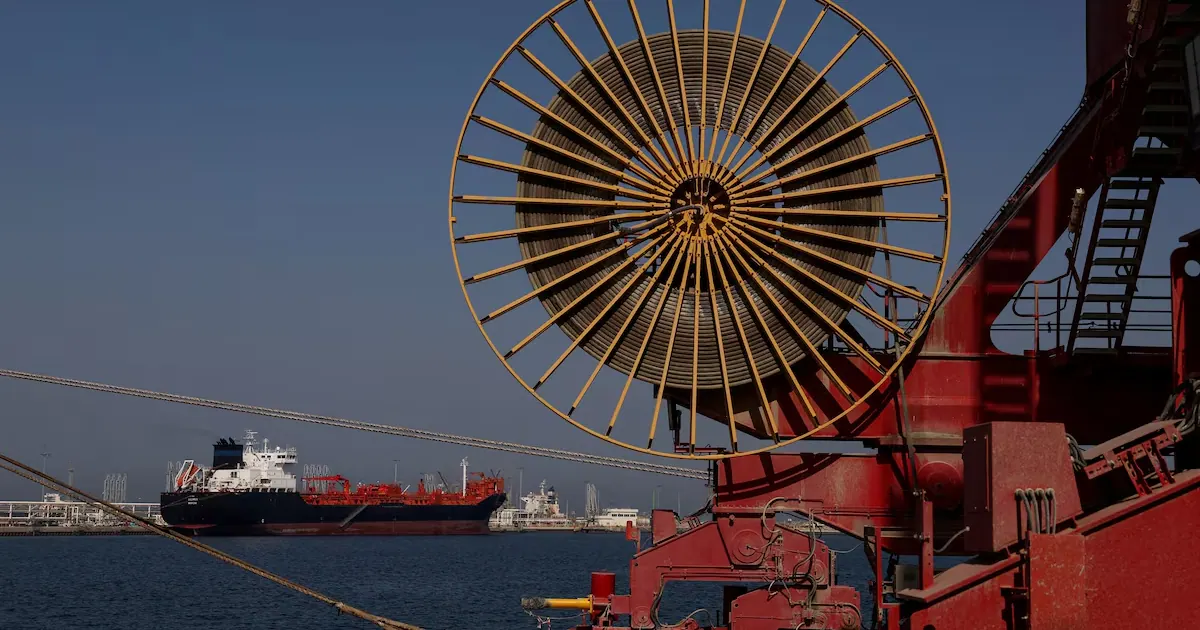
Oil prices have dropped to their lowest in over a week, driven by hopes that diplomacy in the Iran war may gain momentum this week at a UN meeting. Additionally, investors are monitoring a partial recovery in shipments from Saudi Arabia, despite ongoing attacks by Yemen's Houthis. Brent crude futures and US West Texas Intermediate crude reached their lowest since September 10.
At 0213 GMT, Brent crude was trading at $101.71 a barrel, down $2.16 or 2.08%, after a 0.91% decline on Friday. US West Texas Intermediate crude fell $2.15 or 2.14% to $98.15 a barrel, following a 1.58% drop in the previous session. According to Tim Waterer, chief market analyst at KCM Trade, the decline seems to be driven by the removal of a risk premium on hopes of a diplomatic resolution to the US-Iran conflict.
The WTI broke a key psychological support at $100 a barrel, with some investors rolling over their positions in the October contract to November, a day ahead of expiry. Despite this, tensions in the Middle East remain elevated, with Yemen's Iran-backed Houthis claiming to have attacked sensitive sites in the Saudi capital of Riyadh and an Aramco facility in Yanbu.
Iran and the US exchanged new threats on Sunday, with President Donald Trump expressing openness to meeting Iranian President Masoud Pezeshkian, who is expected to be in New York for the United Nations General Assembly. Iran's security chief, Mohsen Rezaei, stated that Iran has conveyed its conditions to mediators for re-engaging in negotiations aimed at ending the war with the US.
China has reportedly asked Iran to help rein in the Houthis after an appeal from Saudi Arabia following the attacks. The Houthi attacks on Saudi Aramco's East-West pipeline prompted the state energy firm to increase exports through the Strait of Hormuz this month and next, after halting some shipments via Yanbu.
Saudi Arabian oil exports have recovered to over 4 million barrels per day (bpd) so far in September, up from 2.4 million bpd in August, according to provisional data from analytics firm Kpler. JPMorgan analysts noted that Middle East oil flows remain surprisingly strong despite disruptions to Saudi Arabia's East-West pipeline.
The analysts added that total oil flows in the past 10 days averaged 17.1 million bpd, just 6.1 million bpd below the 2025 average. Saudi oil moving through the Strait of Hormuz averaged 2.9 million bpd over the past six days, up from just 700,000 bpd in August, according to satellite data.
Key points
- Oil prices have dropped due to hopes of renewed diplomacy in the Iran conflict and a partial recovery in Saudi Arabian shipments.
- Tensions in the Middle East remain elevated despite diplomatic efforts.
- Saudi Arabian oil exports have recovered to over 4 million barrels per day so far in September.