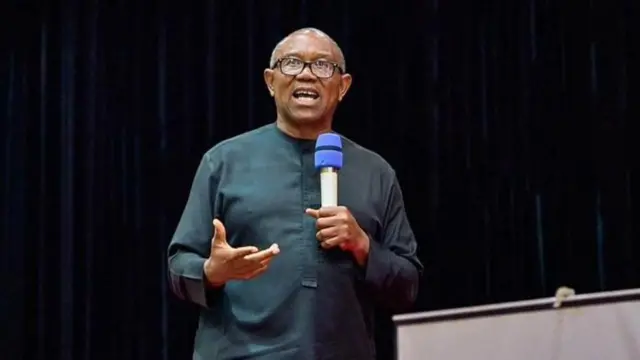
The controversy over Anambra State's financial obligations has taken a fresh turn, with former governor Peter Obi disputing the basis for attributing about N127.4 billion in outstanding external loans to his administration. Obi appeared on Arise TV, where he maintained that he neither approached a financial institution to borrow money nor issued a bond on behalf of Anambra during his eight years in office. He clarified that the facilities were predominantly development programmes involving institutions such as the World Bank and the International Fund for Agricultural Development.
Obi's comments followed claims by the Anambra Government that eight external financing facilities associated with projects during his tenure had an original value of $123.77 million, with $92.35 million, equivalent to about N127.4 billion, outstanding as of June 30, 2026. The state government has said the facilities continue to be serviced from public funds. However, Obi questioned the description of the entire contracted value as debt he left behind, citing the State Education Programme Investment Project as an example.
According to Obi, the arrangement was different from obtaining a conventional commercial loan directly from a bank. He stressed that the drawdown on some of the facilities occurred after he had left office in March 2014. He therefore argued that the timing of each drawdown should be established before responsibility for the resulting obligations is assigned. Obi also challenged the treatment of an approved but undrawn facility as money already borrowed and spent by a government.
Obi illustrated his argument with a hypothetical N10 billion facility, saying a government that received approval for N10 billion but drew only N500 million could not properly be described as owing the entire N10 billion. He added that this was why he said it was not proper public sector accounting. Obi further pointed to what he described as historical records of the Debt Management Office (DMO), arguing that the figures required reconciliation before the current balance could be traced entirely to his administration.
Obi cited DMO records, saying Anambra's external debt was about $18 million when he assumed office in March 2006 and about $30 million when he left in March 2014. He questioned how the $123.77 million figure now being associated with his tenure could be presented as the debt he left behind, particularly when the state's cited outstanding balance was calculated more than 12 years after he left office. Obi also invoked the former DMO Director-General, Abraham Nwankwo, as further evidence of his borrowing record.
Beyond the external financing dispute, Obi maintained that his administration left no outstanding salaries, gratuities or pensions due from the state government at the point of handover. He added that no contractor or supplier whose work had been executed, certified and verified was owed by the state when he left office. However, the Anambra Government has disputed that account, saying it inherited obligations that extended beyond external loans to include salary, pension and gratuity arrears.
The competing accounts have resulted in a continuing public exchange over Anambra's debt profile and the financial legacy of Obi's administration. The latest exchange is part of a broader disagreement over the financial record and legacy of Obi's eight-year administration in Anambra. Obi governed the state from 2006 to 2013, and his claims about the state's finances have consequently remained part of his broader public record, particularly since his entry into national politics.
Key points
- Peter Obi disputes the Anambra debt figure of N127.4 billion, saying it doesn't accurately reflect the financial situation he left behind.
- Obi's administration left no outstanding salaries, gratuities or pensions due from the state government at the point of handover.
- The Anambra Government has disputed Obi's account, saying it inherited obligations that extended beyond external loans to include salary, pension and gratuity arrears.