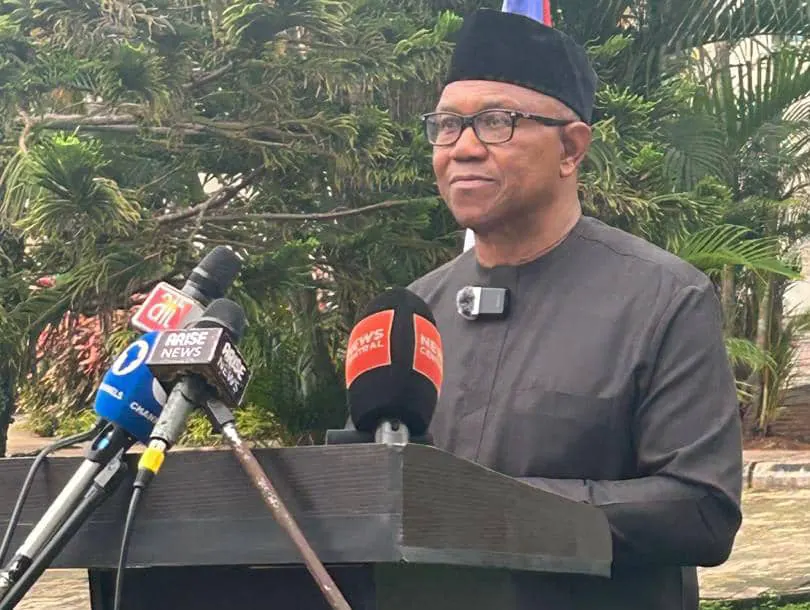
Former Anambra State Governor and presidential candidate of the Nigeria Democratic Congress (ADC), Peter Obi, has addressed the controversy surrounding the borrowing allegations against his administration. In a statement released by his Special Assistant on Media, Dr. Valentine Obienyem, Obi clarified that he neither borrowed cash nor issued bonds during his tenure as governor. He emphasized that his administration left Anambra State in a strong financial position, with no unpaid salaries, gratuities, or pensions.
Obi revealed that he had remained silent on the issue due to the recent loss of his elder brother and friend, Chief Okey Ezeibe. However, he decided to address the matter to set the record straight. According to Obi, during his 10 years in office, he was the only state governor who did not approach the Director-General of the Debt Management Office (DMO), Abraham Nwankwo, for a loan facility. Obi also stated that his administration did not owe any contractor or supplier who had completed work verified and certified by the government.
The controversy surrounding the Anambra debt arose from allegations that Obi's administration left behind a debt of $123.77 million. However, Obi argued that this figure was incorrect and resulted from the combination of three separate categories: the total amount approved for the multi-year development program, the amount Anambra State actually drew during his tenure, and the funding balance outstanding when he handed over in 2014. He stressed that the government must differentiate among these categories to accurately determine the state's debt.
Obi explained that the eight facilities identified were primarily World Bank and IFAD development programs negotiated by the Federal Government, with participating states receiving access to the funds through subsidiary arrangements. He noted that these were not conventional commercial loans that he personally secured during his tenure. Obi emphasized that each facility must be examined in light of its approval, effectiveness, drawdown, and repayment record to determine the state's actual debt.
Obi pointed out contradictions in the government's figures, citing the DMO's published records, which showed Anambra's total external debt at approximately $30 million in March 2014, when he left office, and $45.15 million as of December 31, 2014. He questioned how the state could have inherited $123.77 million from his administration, given these figures. Obi also revealed that he left behind over $150 million as the dollar component of his investment in Anambra State, which was expected to generate approximately $10 million in annual income.
Obi argued that if the state had retained the funds he left behind, including the compound interest on the principal and additional income, the total would be approximately $335 million today. He suggested that if the state had chosen to repay the $92.35 million funding, the entire amount would have been covered, leaving approximately $242 million to be reinvested. Obi concluded by reiterating that he left Anambra State in a strong financial position, the strongest of any state in Nigeria.
Obi urged everyone to focus on the existential challenges confronting Nigeria and the hardships endured by its citizens, rather than on needless distractions in politics. He also pleaded that those in power should allow voters to make their choices in 2027, emphasizing that "a new Nigeria is possible." KEY_POINT: Peter Obi denies allegations of borrowing cash or issuing bonds during his tenure as Anambra State governor. KEY_POINT: Obi clarifies that the $123.77 million debt figure is incorrect and results from a misunderstanding of public-sector accounting. KEY_POINT: Obi reiterates that he left Anambra State in a strong financial position, with no unpaid salaries, gratuities, or pensions.