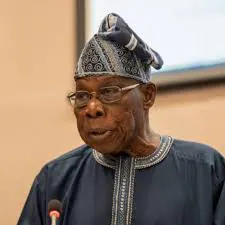
Former President Olusegun Obasanjo has stated that Nigeria cannot achieve meaningful development as long as corruption continues to thrive. He made this statement at the public presentation of "Unexplained Wealth in Nigeria: Law, Prosecution and the Recovery of Illicit Assets," a book authored by Dr. Wahab Shittu, SAN, in Lagos. Obasanjo reflected on his personal experience in the fight against corruption and the establishment of anti-corruption institutions in Nigeria.
Obasanjo shared his experience in the anti-corruption campaign, which dates back to his years in the military. He served as a military prosecutor and member of a court martial dealing with corruption-related issues. His commitment to the cause deepened after leaving office as military head of state and becoming a farmer. Peter Eigen, a former World Bank official, approached him, exposing him to "grand corruption," particularly the diversion of funds from international loans.
Obasanjo and Eigen established Transparency International, with Eigen as chairman and Obasanjo as chairman of its advisory council. As democratically elected President, Obasanjo's experience with Transparency International influenced his decision to prioritize the fight against corruption. The organisation provided him with a model anti-corruption law, which was adapted into Nigerian law and became the basis for establishing the Independent Corrupt Practices and Other Related Offences Commission (ICPC).
Obasanjo revealed that the ICPC bill initially faced resistance in the National Assembly. Lawmakers told him that if they passed the bill as he gave it to them, most of them would end up in prison. It took 18 months for the lawmakers to pass the legislation. After the passage of the ICPC law, Obasanjo established the Economic and Financial Crimes Commission (EFCC) to strengthen the fight against corruption.
According to Obasanjo, corruption disproportionately affects poor people by worsening their economic circumstances. "Those who suffer most in a corrupt society are the poorest. And it makes them poorer," he said. He described corruption in various forms, including unexplained wealth and illicit funds, as "antisocial," "anti-development," and "anti-progress."
Obasanjo emphasized that corruption is fundamentally incompatible with development. "One big handicap to development is corruption. Corruption and development are strange bedfellows. They can't go together," he said. He added that corruption is not in the best interest of any country or human organisation.
The former President concluded that Nigeria must continue to fight corruption to achieve meaningful development. He encouraged Nigerians to support efforts to combat corruption, citing its negative impact on the country's progress. Obasanjo's remarks underscore the need for sustained efforts to address corruption in Nigeria.
Key points
- Obasanjo revealed that lawmakers told him they'd go to prison if they passed his anti-corruption bill.
- Corruption disproportionately affects poor people, worsening their economic circumstances.
- Obasanjo emphasized that corruption is fundamentally incompatible with development.