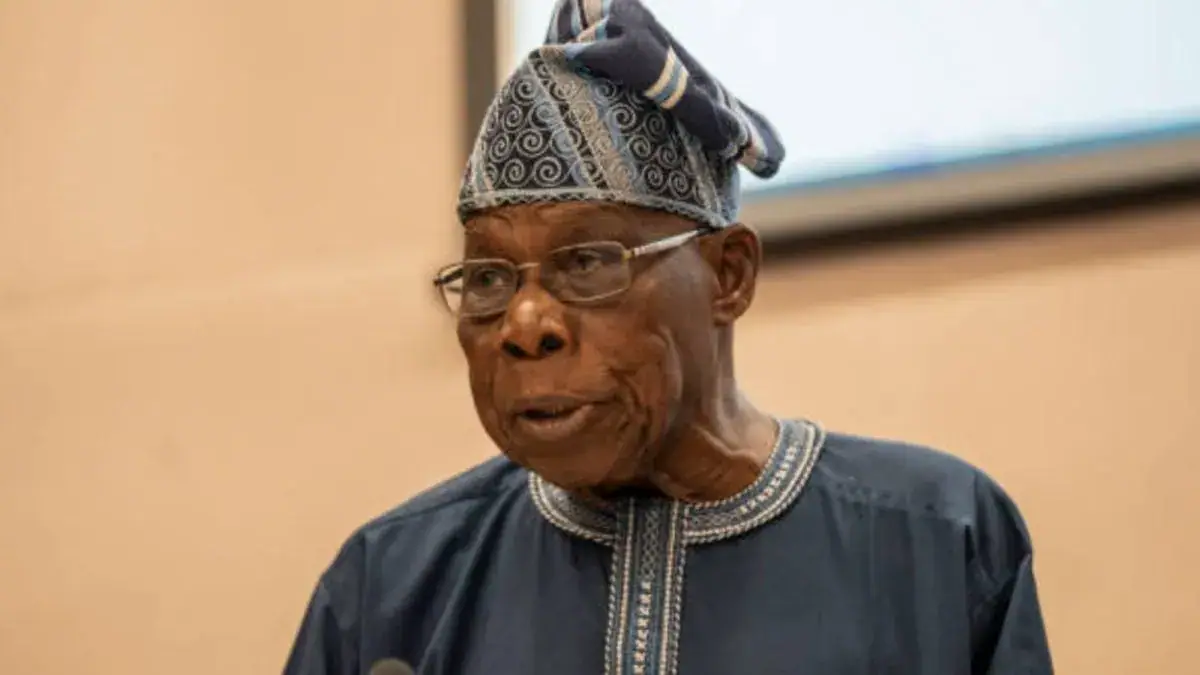
Former President Olusegun Obasanjo has expressed concerns over Nigeria's growing debt burden, criticizing President Bola Tinubu's administration for its position on borrowing. Obasanjo stated that excessive borrowing not only affects the current government but also places a significant financial burden on future generations of Nigerians. He made these remarks at the third Ajibosin Annual Symposium held at the Olusegun Obasanjo Presidential Library in Abeokuta, Ogun State.
The symposium, themed "Leveraging Artificial Intelligence to Solve Grassroots Problems and Accelerate National Development," provided a platform for Obasanjo to question the justification for Nigeria's continued dependence on borrowing. He argued that the problem lies not in obtaining loans but in the long-term consequences of accumulating debts without sufficient consideration for the country's ability to repay them. Obasanjo recalled the debt relief secured by his administration through negotiations with the Paris Club, which resulted in the cancellation of about $30 billion of Nigeria's external debt.
Obasanjo criticized the influence of international financial institutions, particularly the World Bank and the International Monetary Fund, on Nigeria's economic policies. He argued that policies promoted by these institutions are not necessarily designed around the needs and development priorities of African countries. Obasanjo cited an example of agricultural subsidies in Britain, where farmers receive government support for every sheep they own, questioning why Nigeria is discouraged from supporting its agricultural sector.
The former president expressed concern over the declining value of the naira, using his personal experience in agriculture to illustrate the extent of the currency's depreciation. He recalled that when he established his farm about 47 years ago, the exchange rate stood at approximately N1 to $1.85, questioning how the country had arrived at an exchange rate of about N1,500 to the dollar. Obasanjo emphasized that debt is worse than leprosy because it destroys generations, not just individuals.
Obasanjo's criticism comes amid fresh borrowing proposals by the Tinubu administration, which recently sought legislative approval for a supplementary external borrowing plan involving $20.52 billion and €1.045 billion. The proposed financing covers areas including power, transportation, healthcare, education, agriculture, water supply, security, and job creation. Obasanjo warned that Nigeria should be more cautious about returning to a situation where a significant portion of its resources is committed to servicing debts.
Beyond the debt controversy, Obasanjo raised concerns about Nigeria's readiness to embrace artificial intelligence and other emerging technologies. He warned that African countries could expose themselves to new forms of exploitation if they adopted foreign technologies without developing the capacity to control them. Obasanjo emphasized that control over technology is essential to preventing its misuse.
The concerns were also raised by Dr. Umar Ardo, a historian and political commentator who delivered a lecture at the event. He warned that Africa could face another phase of economic exploitation through artificial intelligence if countries on the continent failed to establish control over the technology. Obasanjo's comments have sparked a national debate on the country's borrowing policy and its implications for future generations.
Key points
- Obasanjo criticizes Tinubu's borrowing policy, warning that Nigeria's growing debt burden poses a greater danger to the country than leprosy.
- The former president questions the justification for Nigeria's continued dependence on borrowing, citing the long-term consequences of accumulating debts.
- Obasanjo warns that African countries could expose themselves to new forms of exploitation if they adopt foreign technologies without developing the capacity to control them.