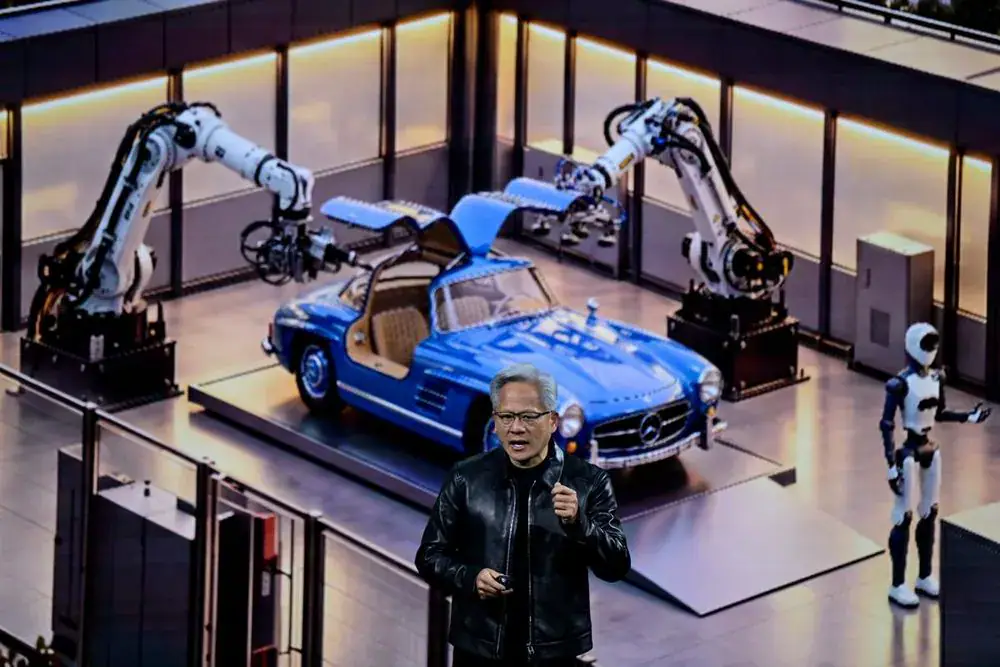
Jensen Huang, co-founder and former CEO of Nvidia, has stepped down from his position after 33 years, following revelations about his private life that triggered political scrutiny and national security concerns. The 63-year-old Huang, who transformed Nvidia into one of the world's most influential technology companies, resigned as CEO and relinquished his seat on the board. His departure has sent shockwaves through the global artificial intelligence industry, which relies heavily on Nvidia's processors.
Huang's journey to becoming a tech giant began in Taipei in 1963, where he was born and later moved to the United States as a child. At the age of nine, he was sent to a boarding school in Kentucky with his brother, where he faced bullying and struggled with English. Despite the challenges, Huang developed a strong work ethic and went on to study engineering. He joined chipmakers AMD and LSI Logic before co-founding Nvidia in 1993 with two colleagues. The company initially focused on developing powerful processors for computer graphics and video games.
Nvidia's fortunes changed dramatically with the launch of ChatGPT in 2022, which led to a surge in demand for powerful processors needed to train and operate AI models. The company's market valuation climbed to approximately $4.5 trillion, making it one of the world's most valuable companies. Huang's personal fortune was estimated at around $160 billion, largely reflecting his shareholding in the business. He became a celebrity in his native Taiwan, where public appearances regularly attracted crowds of admirers.
Huang's downfall followed revelations about two alleged extramarital relationships, which he acknowledged and apologized for. One reported relationship involved Alice Huang, a former senior executive at Singapore-based data centre company Megaspeed. US intelligence reportedly circulated a memo alleging that Alice Huang was an asset of China's Ministry of State Security, which Beijing has rejected. Singapore confirmed that it had barred her from re-entering the country in February after she provided investigators with inaccurate information about her role at Megaspeed.
The allegations have developed into a significant political issue in Washington, particularly due to Nvidia's importance to the global technology industry and the strategic competition between the US and China. Republican Senator Tim Scott has requested that Huang and US Commerce Secretary Howard Lutnick testify before the Senate Banking Committee in December. Three House of Representatives committees have also called for a closed-door interview with Huang on December 1, threatening a subpoena if necessary.
Lawmakers want answers about what the US administration knew regarding Huang's reported connections to Alice Huang and whether concerns surrounding Megaspeed were adequately investigated. Reports have alleged that the Commerce Department may have failed to act on suspicions that Megaspeed was helping divert restricted Nvidia technology to China. Singapore's Home Affairs Ministry said it had repeatedly sought information from the US Justice Department and FBI during its investigation into Megaspeed, but received limited assistance.
Nvidia's chief financial officer Colette Kress has been appointed interim CEO while the board considers internal and external candidates for a permanent replacement. Potential candidates mentioned in media and analyst discussions include AMD CEO Lisa Su, Arm CEO Rene Haas, and former Apple CEO Tim Cook, who was publicly endorsed by US President Donald Trump. The board has indicated that it will consider both internal and external candidates to succeed Huang.
Key points
- Jensen Huang's resignation as Nvidia CEO follows allegations of extramarital relationships and national security concerns.
- Huang's departure has triggered uncertainty in the AI industry, which relies heavily on Nvidia's processors.
- The US government is investigating the allegations and potential connections to China's Ministry of State Security.