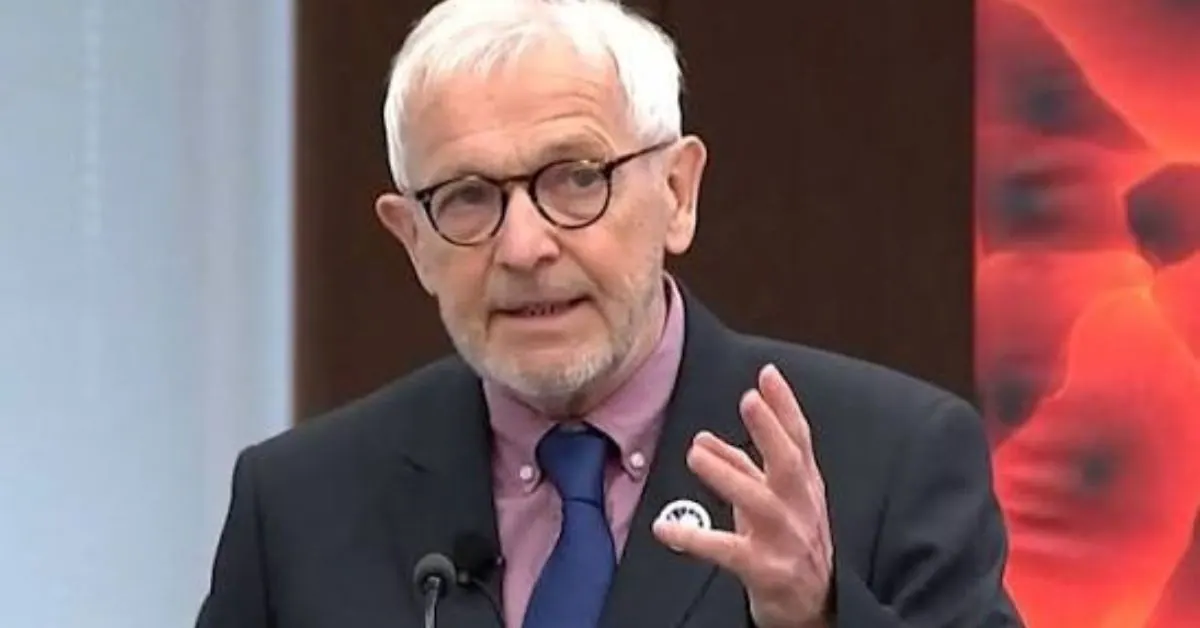
The Royal Swedish Academy of Sciences announced on Tuesday that Francis Halzen, a renowned physicist, has been awarded the 2026 Nobel Prize in Physics. This prestigious honor recognizes his pivotal role in the development of the IceCube Neutrino Observatory and the groundbreaking discovery of high-energy neutrinos of astrophysical origin. The observatory, described as a kilometer-cube-sized ice block equipped with light sensors, has enabled scientists to detect rare subatomic particles produced by immense energy processes in the distant universe.
Halzen, 82, was born in Tienen, Belgium, and is currently a professor at the University of Wisconsin-Madison in the United States. His work on the IceCube project has been instrumental in advancing our understanding of the universe. The observatory, located at the South Pole, allows researchers to detect neutrinos, which are elusive particles that can provide valuable insights into cosmic phenomena. This discovery has opened up new avenues for research in astrophysics and particle physics.
The Nobel Prize in Physics is one of the most esteemed awards in the scientific community, and Halzen's win is a testament to his dedication and contributions to the field. In response to the announcement, Halzen expressed his surprise and delight, stating that he was not expecting the award. He emphasized his immense happiness upon hearing the news, highlighting the significance of this recognition for his work.
The IceCube Neutrino Observatory is a remarkable instrument that has enabled scientists to study high-energy neutrinos from distant sources. By detecting these particles, researchers can gain insights into the most powerful astrophysical processes in the universe, such as supernovae explosions and the behavior of black holes. Halzen's work on the observatory has paved the way for further research in this field, and his Nobel Prize is a well-deserved recognition of his achievements.
This year's Nobel Prize in Physics is the second major award to be announced, following the Nobel Prize in Medicine awarded on Monday to Carl Deisseroth, Peter Hegemann, and Jörg Nagel for their work on the molecular mechanisms of light perception. The Nobel Prizes are considered the highest honors in their respective fields, and Halzen's win is a testament to the significance of his contributions to physics.
The Royal Swedish Academy of Sciences, which awards the Nobel Prizes, emphasized the importance of Halzen's work in advancing our understanding of the universe. The academy's decision to award him the Nobel Prize in Physics recognizes the impact of his research on the scientific community and the broader public. Halzen's achievement serves as an inspiration to scientists and researchers around the world, highlighting the importance of dedication and perseverance in pursuing groundbreaking discoveries.
The Nobel Prize in Physics will be officially awarded to Francis Halzen at a ceremony later this year. This recognition is expected to further enhance his reputation as a leading figure in the field of physics, and his work will continue to inspire future generations of scientists and researchers. The discovery of high-energy neutrinos has opened up new avenues for research, and Halzen's Nobel Prize is a testament to the significance of his contributions to this field.
Key points
- Francis Halzen wins 2026 Nobel Prize in Physics for contributions to IceCube Neutrino Observatory
- The IceCube Neutrino Observatory has enabled scientists to detect high-energy neutrinos from distant sources
- Halzen's work has paved the way for further research in astrophysics and particle physics