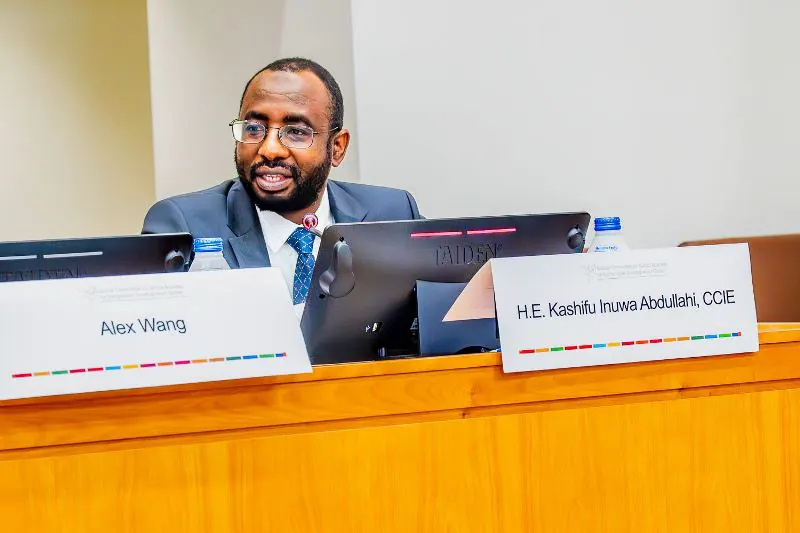
The Director-General and Chief Executive Officer of the National Information Technology Development Agency (NITDA), Kashifu Inuwa Abdullahi, has called for a more inclusive approach to artificial intelligence (AI) that enables people to understand, shape, and benefit from the technology. Abdullahi made this call during a high-level global dialogue on technology, innovation, and social business for sustainable and inclusive development. The event brought together prominent figures, including political leaders, development advocates, and technology stakeholders.
The global dialogue featured several notable participants, including the President of the 81st Session of the United Nations General Assembly, Dr. Khalilur Rahman; President of Timor-Leste, José Ramos-Horta; Bhutanese Prime Minister Tshering Tobgay; Brazil’s State Minister of Development and Social Assistance, Family and Fight Against Hunger, Wellington Dias; and Pakistan’s Minister of State and Chairman of the Virtual Assets Regulatory Authority, Bilal Bin Saqib. Nobel Peace Laureate and Grameen Bank founder, Professor Muhammad Yunus, also participated in the session.
In his keynote address, Abdullahi emphasized that the global conversation on AI should move beyond expanding access to technology to ensuring that people are represented in the systems being developed and have the ability to influence and create value from them. He stressed that inclusive AI requires representation and access, and that access must mean agency, not just consumption. Abdullahi used agriculture as an example, describing how AI could provide a Nigerian farmer with access to expertise that might otherwise be unavailable.
Abdullahi identified four pillars of Nigeria’s approach to inclusive AI development: Connect, Skill, Compute, and Create. He referenced initiatives aimed at expanding connectivity, developing digital and technical skills, strengthening sovereign cloud and AI capabilities, and creating an environment where entrepreneurs can develop technology solutions to address societal challenges. The NITDA DG also emphasized the importance of digital sovereignty, stating that Nigeria’s objective was not to isolate itself technologically but to develop the capacity to ensure that AI systems understand Nigerian data, contexts, and nuances.
Abdullahi called for greater cooperation between governments, technology companies, and citizens. He suggested that governments should provide infrastructure, clear policies, and regulatory certainty while protecting citizens. Technology companies, he said, should move beyond selling products in Africa to investing in local computing capacity, transferring knowledge, developing talent, and supporting African datasets, languages, researchers, and innovators.
A major part of Abdullahi’s address focused on accountability as AI becomes increasingly involved in areas such as healthcare, livelihoods, rights, and public services. He emphasized that accountability cannot be delegated to machines and urged policymakers, technology companies, and innovators to consider who is represented in the intelligence being developed and who has the agency to shape it and benefit from it.
Through NITDA, Abdullahi said Nigeria remained committed to developing an AI ecosystem in which representation promotes relevance, access creates opportunities, and agency enables Nigerians to become creators rather than merely consumers of AI. He concluded that Nigeria’s vision for AI should ultimately be measured not only by technological advancement but by its ability to improve human lives and unlock extraordinary human possibility for everyone.
Key points
- Kashifu Inuwa Abdullahi calls for inclusive AI development that enables people to understand, shape, and benefit from the technology.