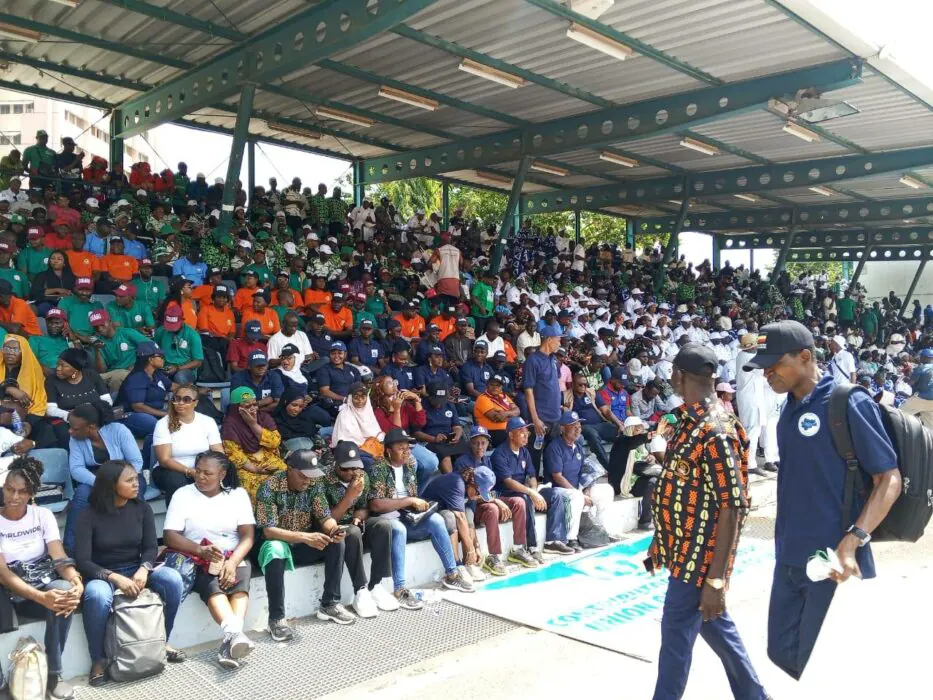
A three-day warning strike declared by the Joint National Public Service Negotiating Council (JNPSNC) recorded limited compliance in parts of the Federal Capital Territory and several states across Nigeria. Civil servants in several government offices reported for work and carried out their normal duties. The strike, which commenced recently, was in response to the federal government's failure to meet demands by public service unions over the worsening economic situation and other labour-related issues.
In Abuja, workers at the Federal Ministry of Health, Federal Ministry of Education, FCT Administration Secretariat, and the Federal Capital Development Authority (FCDA) reported for duties. They were seen attending to files, moving between offices, and carrying out routine administrative assignments. Many workers claimed they were unaware of the strike, citing a communication gap between union leadership and some workers.
At the Federal Ministry of Health in Abuja, a civil servant, Mr. Roland Agbo, said he was unaware of the strike. "I came to work this morning as I normally do. I was not aware that there was a strike. Nobody informed me that workers were expected to stay away from the office," he said. Similar sentiments were expressed by workers at the Federal Ministry of Education and the FCTA Secretariat.
The strike's limited compliance was observed in various states, including Osogbo, Ilorin, Umuahia, Akure, Calabar, and Makurdi. In many government offices visited, workers were seen at their duty posts, attending to official matters. Although the level of compliance varied from one ministry, department, or agency to another, the strike did not completely shut down government offices.
Some workers expressed surprise when informed about the strike, stating they had not received any directives from their offices to stay away from work. Haruna Lawal, a worker at the FCTA Secretariat, attributed the limited compliance to a communication gap between union leadership and some workers. "I was not aware that today was the commencement of the strike. I reported for work as usual because there was no directive from my office telling me not to come," he said.
The JNPSNC had directed public servants to fully comply with the warning strike. However, the development showed that many workers chose to report for duty, despite the directive. The council's efforts to address labour-related issues and improve working conditions for public servants have been ongoing, but the limited compliance with the strike may indicate a need for better communication and negotiation strategies.
The warning strike's outcome may have implications for future labour negotiations and actions in Nigeria. The JNPSNC and the federal government may need to revisit their communication strategies and negotiation approaches to ensure that workers' concerns are addressed effectively. The situation may also highlight the need for improved labour relations and better working conditions for public servants in Nigeria.
Key points
- The Joint National Public Service Negotiating Council's three-day warning strike recorded limited compliance in many Nigerian states.
- Many workers claimed they were unaware of the strike, citing communication gaps between union leadership and some workers.
- The limited compliance may indicate a need for better communication and negotiation strategies between the JNPSNC and the federal government.