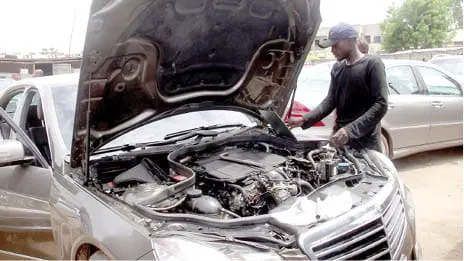
In Maiduguri, the capital of Borno State, a quiet revolution is underway as young graduates of engineering and computer science from the University of Maiduguri swap their certificates for spanners and grease pits. This shift is a departure from the traditional pursuit of secure office jobs, and is being driven by the harsh realities of the Nigerian job market. Many graduates are finding that white-collar jobs are scarce, and are instead turning to auto mechanics as a viable alternative.
Musa Bala, a Computer Science graduate from the University of Maiduguri, is one such individual who has made the switch. Despite finishing with impressive grades, Bala found himself facing a bleak job market, with no white-collar jobs in sight. Rather than waiting indefinitely for a government or corporate appointment, Bala enrolled as an apprentice under a veteran local mechanic, merging his analytical and problem-solving skills with practical mechanics.
Bala's decision to trade his certificate for a career in auto mechanics has paid off, with him now earning N25,000 daily and at least N450,000 monthly. His technological approach to vehicle repairs has attracted a surge of new customers, significantly boosting the workshop's daily revenue. Bala's success has sent shockwaves through the academic community in Maiduguri, with a growing number of graduates from engineering, computer science, and other fields joining the business.
Abdulwasiu Jimoh, a graduate of Electrical and Electronics Engineering with a master's degree in Disaster Management, is another example of a graduate who has made the switch. Influenced by his father's philosophy that every child must possess a practical skill, Jimoh had a long-time passion for automobile repairs. Despite being offered salaried positions of N250,000 upwards, Jimoh routinely turns them down, preferring the freedom and financial rewards of being his own boss.
Jimoh's decision to pursue a career in auto mechanics has given him the financial stability and independence he needs to support his family. He advises fellow graduates to abandon the endless wait for scarce office jobs and instead acquire vocational skills. According to Jimoh, "A skill is better than getting a degree. You can get the skill and still get the degree." He believes that graduates should rethink their approach and focus on acquiring skills that will make them self-reliant.
Ahmed Abba, a mechanical engineer who graduated from the University of Maiduguri, is another graduate who has found success in the auto mechanics trade. Abba's father took him to a workshop to learn the skills, and he has since built a successful business. He believes that acquiring vocational skills is essential for graduates, and that it has given him the financial stability and independence he needs to support his family.
The influx of university-educated youths into the informal sector has transformed the landscape of Maiduguri, with many graduates now pursuing careers in auto mechanics and other vocational trades. As the Nigerian job market continues to evolve, it remains to be seen whether this trend will continue, but for now, it seems that many graduates are finding success and financial stability in the auto mechanics trade.
Key points
- Many Nigerian graduates are trading university certificates for careers in auto mechanics due to the harsh realities of the job market.
- Graduates such as Musa Bala, Abdulwasiu Jimoh, and Ahmed Abba are finding success and financial stability in the auto mechanics trade.
- The trend is transforming the landscape of Maiduguri, with many graduates now pursuing careers in vocational trades.