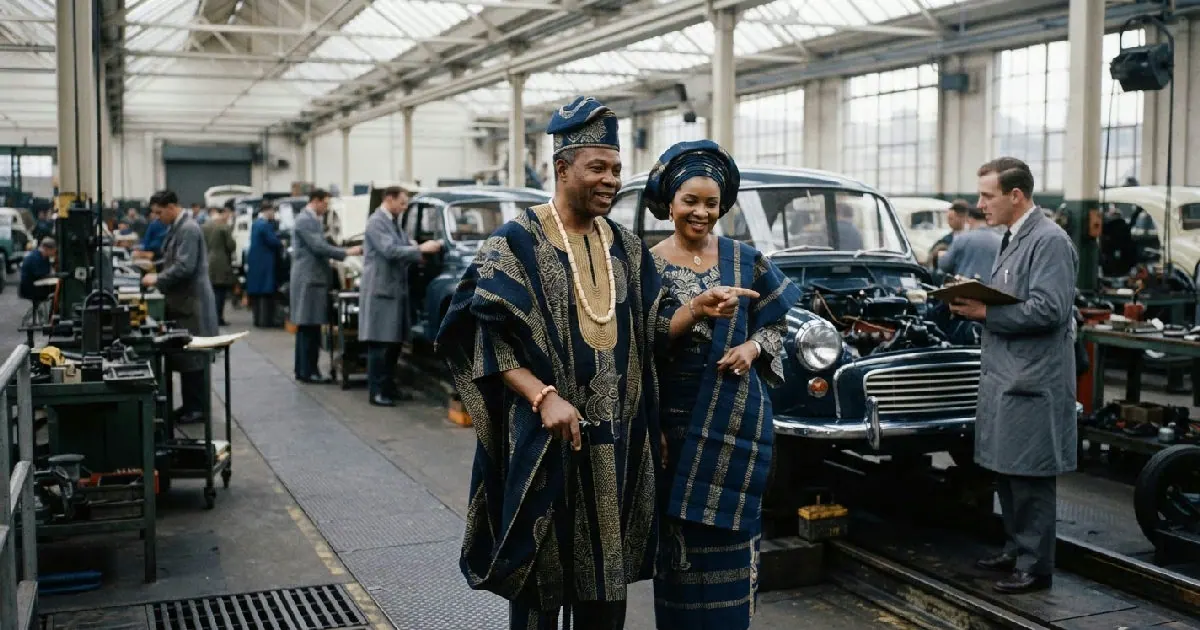
In 1966, Nigerian Chief T.O. Kuti made a notable visit to a major British automobile plant, not as a delegate, but as a customer. This visit highlighted the growing international reach of British manufacturing and Kuti's personal engagement in international trade. A historical photographic account captured the moment, revealing a forgotten chapter of Nigerian economic history. Kuti's visit showed a level of personal engagement in international trade that feels almost impossible today.
Chief T.O. Kuti, hailing from Ijebu-Igbo, a key commercial town in what is now Ogun State, was a pioneer in Nigeria's transport industry. Before becoming a titan of the industry, famously known as Abusi Odumare, Kuti was a schoolteacher. In 1942, during World War II, he sold a house he had built and used the proceeds to acquire his first lorry. This single vehicle was the genesis of what would become a formidable transport business.
Kuti's investment in the transport sector was strategic, as the colonial era in Nigeria saw agricultural production as the bedrock of the economy. Motor transport began filling crucial gaps in a network largely served by rail and waterways. Entrepreneurs who invested in lorries were effectively creating new commercial arteries, connecting previously isolated communities to wider markets. Kuti entered this vital sector at a pivotal moment, recognising the growing demand for road transportation in southwestern Nigeria.
Chief Kuti's ambition didn't stop at operating a single lorry; he systematically expanded his fleet from one vehicle to six. This expansion demanded greater organisational skill and a keen eye for managing a burgeoning enterprise. Kuti identified a critical unmet need within the industry: access to vehicles and capital for other aspiring transporters. He began selling vehicles through hire-purchase arrangements and importing vehicles directly from Europe.
The hire-purchase model was revolutionary for its time, enabling individuals who lacked the upfront capital to buy a vehicle outright to still enter the transport business. Kuti's business evolved into a linchpin, connecting smaller operators with the necessary tools to build their own livelihoods. His involvement in vehicle importation positioned his business within the international commercial networks that brought foreign-manufactured automobiles to Nigerian shores.
A legal dispute that reached Nigeria's Supreme Court in the 1970s provided proof of Kuti's established and sophisticated business model. The case, T.O. Kuti and Another v. Oludademu Jibowu and Another, stemmed from an accident involving a Morris minibus supplied by Kuti under a hire-purchase agreement. The Supreme Court ultimately ruled in Kuti's favor in June 1972, concluding that the driver was not Kuti's employee or agent.
The Morris Minor, the car Chief Kuti collected that day in Oxfordshire, holds its own significant place in automotive history. Introduced in 1948, it became one of Britain's most iconic post-war automobiles, known for its practical design and affordability. By 1961, it became the first British car to sell over a million units, with more than 1.6 million produced by the end of its run in 1971.
Key points
- Chief T.O. Kuti visited a British Morris car factory in 1966, showcasing his international trade engagement.
- Kuti's business evolved into a linchpin, connecting smaller operators with the necessary tools to build their own livelihoods.
- The hire-purchase model was revolutionary for its time, enabling individuals to enter the transport business.