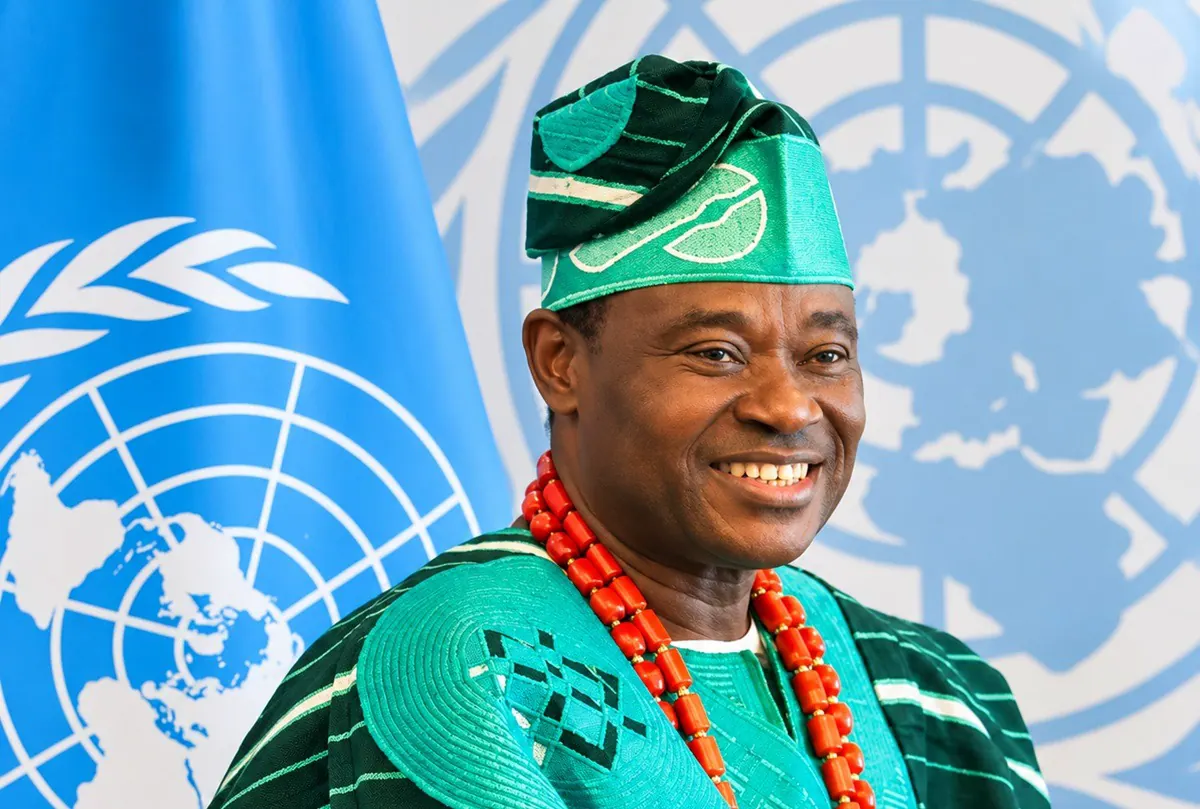
Nigeria has demanded the complete elimination of nuclear weapons, warning that humanity cannot continue to rely on weapons capable of destroying civilization as instruments of collective security. Ambassador Jimoh Ibrahim, Nigeria's Permanent Representative to the United Nations, made the call at a high-level UN General Assembly meeting in New York commemorating the International Day for the Total Elimination of Nuclear Weapons.
Ibrahim emphasized that Nigeria neither possesses nor intends to develop nuclear weapons, and that the country's security does not depend on such weapons. He stated that enduring global security should be anchored on dialogue, international law, multilateral cooperation, and the equal security of all countries. President Bola Tinubu's administration remains committed to international efforts aimed at achieving a world free of nuclear weapons.
The meeting was held against the backdrop of growing international concerns over the continued existence of nuclear arsenals, the modernization of nuclear weapons, and the weakening of global arms-control arrangements. Ibrahim urged nuclear-weapon States to fulfill their disarmament obligations under the Nuclear Non-Proliferation Treaty, while supporting the peaceful use of nuclear science and technology for healthcare.
UN Secretary-General António Guterres warned that the world is experiencing its most dangerous nuclear moment since the end of the Cold War, with nuclear arsenals being expanded and modernized while arms-control safeguards are weakening. He expressed concern over the expiration of the New START Treaty, which had imposed limits on the strategic nuclear arsenals of the United States and Russia.
Guterres lamented the deterioration of nuclear arms control, which threatens not only nuclear-weapon States but the entire international community. He cited the failure of efforts under the NPT framework to produce substantive consensus on key issues. The Secretary-General emphasized that 81 years after the atomic bombings of Hiroshima and Nagasaki, nuclear weapons continue to cast a dark shadow over humanity.
Ibrahim reaffirmed Nigeria's strong commitment to the NPT, describing it as a cornerstone of the international nuclear non-proliferation regime. He encouraged countries that have yet to join the Treaty on the Prohibition of Nuclear Weapons to consider doing so as part of collective efforts to eliminate nuclear weapons. Africa has already demonstrated what is possible through the Treaty of Pelindaba, which established the continent as a nuclear-weapon-free zone.
Nigeria's call for the elimination of nuclear weapons is part of a broader effort to promote global disarmament and non-proliferation. The country's envoy pointed to the risks of miscalculation, escalation, and catastrophic humanitarian consequences associated with the continued modernization of nuclear weapons and reliance on nuclear deterrence. The international community must work together to address these risks and promote a world free of nuclear weapons.
Key points
- Nigeria's Ambassador to the UN, Jimoh Ibrahim, calls for complete elimination of nuclear weapons.
- UN Secretary-General António Guterres warns of the most dangerous nuclear moment since the end of the Cold War.
- Nigeria reaffirms its commitment to the Nuclear Non-Proliferation Treaty and encourages countries to join the Treaty on the Prohibition of Nuclear Weapons.