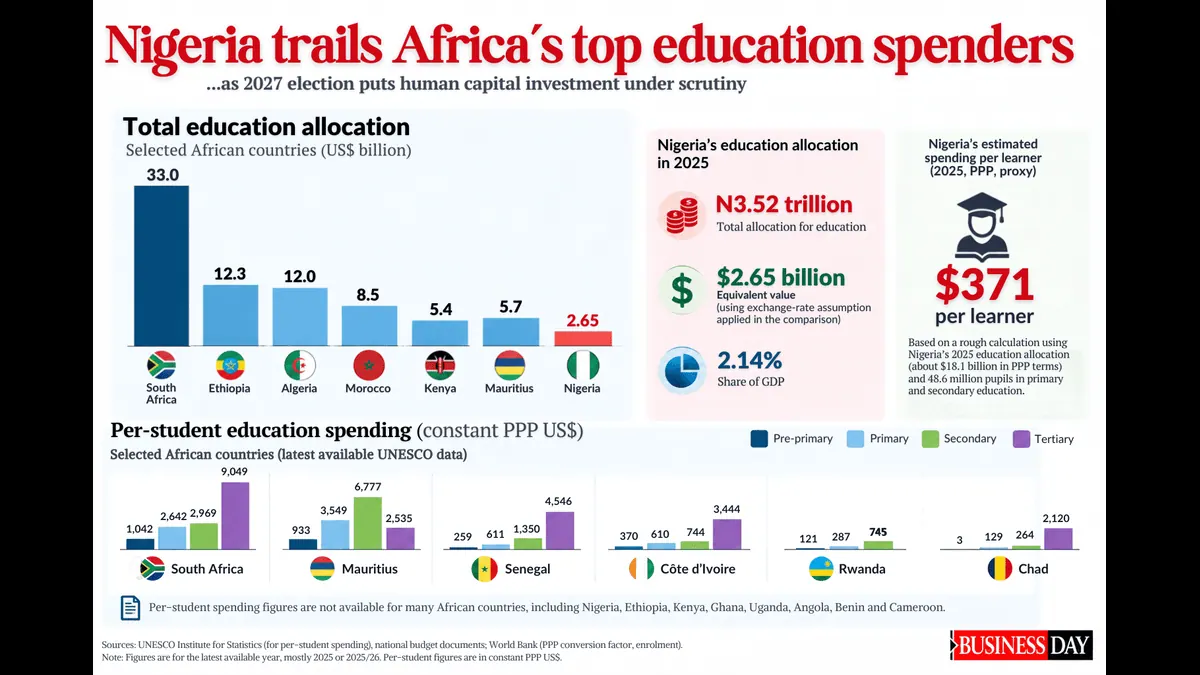
Nigeria's federal allocation for education stands at $2.65 billion, a figure that places the country far behind its African peers in terms of education spending. The allocation, which represents about 2.14 percent of Nigeria's GDP, is spread across 48.6 million pupils enrolled in primary and secondary education, amounting to about $371 per learner. This disparity in education spending has become a significant concern as Nigeria heads towards the 2027 presidential election, with human capital development as a key measure of the government's economic and social policy.
In comparison, South Africa committed about $33 billion to education in its 2025/26 fiscal cycle, with the allocation estimated at more than R500 billion. The country's education sector received nearly 24 percent of its overall government spending. Ethiopia allocated about $12.3 billion to education, while Algeria's allocation was estimated at about $12 billion. Morocco and Kenya also made significant allocations, with Morocco committing about $8.5 billion and Kenya approximately $5.4 billion, equivalent to about 16.6 percent of its national budget.
The UNESCO Institute for Statistics attributed the data on education spending for various countries. According to UNESCO, education has historically accounted for a substantial share of Ethiopia's public investment, although more recent figures put education spending at roughly 3.74 percent to 4.07 percent of GDP. Algeria's education sector received 15.54 percent of total government expenditure in 2025, down from 23.89 percent in 2024.
A significant challenge in comparing education spending across countries is the lack of per-student expenditure data. UNESCO-linked data show that per-student spending figures are missing for many African countries, including Nigeria, Ethiopia, Kenya, Ghana, Uganda, Angola, Benin, and Cameroon. However, where data are available, the differences are substantial, with South Africa's per-student expenditure reported at $1,042 for pre-primary education, $2,642 for primary, $2,969 for secondary, and $9,049 for tertiary education.
Other countries with available per-student expenditure data include Mauritius, Senegal, Côte d'Ivoire, Rwanda, and Chad. Mauritius recorded $933 per student at pre-primary level, $3,549 at primary level, $6,777 at secondary level, and $2,535 at tertiary level. Senegal and Côte d'Ivoire also reported varying per-student expenditures across different levels of education. The absence of comparable per-student data for Nigeria limits what can be inferred about the efficiency or adequacy of its education spending.
Education experts have emphasized the need for Nigeria to prioritize education and human capital development. Kingsley Moghalu, president of the Institute for Governance and Economic Transformation, said Nigeria needs an education system that places greater emphasis on access, quality, literacy, skills, and national values. Moghalu argued that the purpose of education should be central to policymaking and that the strength of a country's socio-economic system is closely linked to the strength of its education system.
Mojeed Alabi, Education expert and president of the Education Writers Association of Nigeria, attributed Nigeria's poor education funding to misplaced priorities. Alabi warned that poor funding, misplaced priorities, and a weak reward system are undermining the country's education development. He called for a change in attitude towards education by both government and citizens, emphasizing that sustainable national development would remain difficult without greater investment in quality education.
Key points
- Nigeria's education allocation is significantly lower than that of its African peers.
- The country's per-student expenditure data is not available, limiting comparisons with other countries.
- Education experts emphasize the need for Nigeria to prioritize education and human capital development.