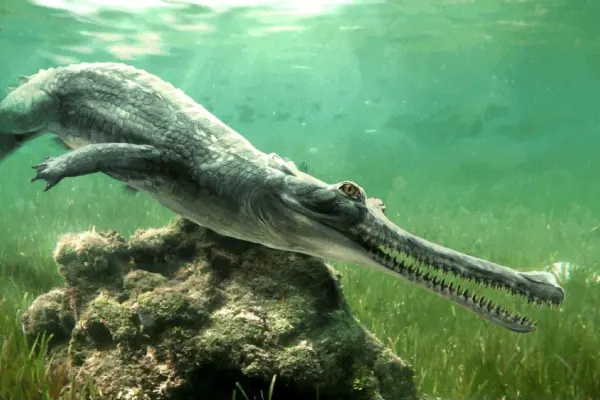
Egypt's Minister of Higher Education and Scientific Research, Dr. Abdel Aziz Qanswa, congratulated Mansoura University on its participation in an international study that has identified a new species of ancient crocodile. The study, which was published in the Royal Society Open Science journal, involved re-examining a 45-million-year-old fossil found in Egypt's Gebel Qatrani formation in 1927. The fossil was discovered to be a new genus of crocodile, named "Hierogavialis."
The study was conducted by a team of researchers from Mansoura University's Vertebrate Paleontology Center, led by Dr. Hisham Salam, in collaboration with international researchers. The team used advanced scientific techniques to re-examine the fossil and determine its evolutionary relationships. The new species, Hierogavialis kayrensis, was found to be a distant relative of the modern gharial, a species of crocodile found in India.
The discovery was hailed as a significant achievement for Egyptian scientific research, highlighting the country's capabilities in producing high-quality research in specialized scientific fields. Mansoura University's Vice President for Graduate Studies and Research, Dr. Tarek Mostafa Ghlush, emphasized the importance of specialized research centers in producing new knowledge and advancing scientific understanding.
The fossil, which was previously known as "Tomistoma kayrensis," was found to have a distinctive long snout and skull structure. The study's findings provide new insights into the evolutionary history of crocodiles in Egypt and the Mediterranean region. The research also highlights the importance of re-examining existing fossil collections to gain new understanding of ancient species.
The study's lead author, Dr. Paul Berk, noted that the Mediterranean region has been a hotspot for crocodile diversity over the past 50 million years. The discovery of Hierogavialis kayrensis adds to our understanding of this diversity and how it changed over time. The research suggests that crocodile populations in the region declined during the late Eocene and Oligocene epochs, possibly due to changes in climate and sea levels.
The name "Hierogavialis" is derived from the Egyptian god Horus, who was associated with the Sphinx, and the scientific name for the gharial. The species name "kayrensis" refers to the city of Cairo. The discovery has been hailed as a significant find for Egyptian paleontology, highlighting the country's rich fossil heritage and the importance of continued research into its ancient species.
The study is part of a larger project to study the diversity of fossil crocodiles in Egypt and North Africa. The researchers hope that their work will contribute to a greater understanding of the evolution and extinction of these ancient species. The study's findings have implications for our understanding of the history of life on Earth and the evolution of species over time.
Key points
- The discovery of Hierogavialis kayrensis highlights Egypt's contributions to scientific research and the importance of continued exploration of its fossil heritage.