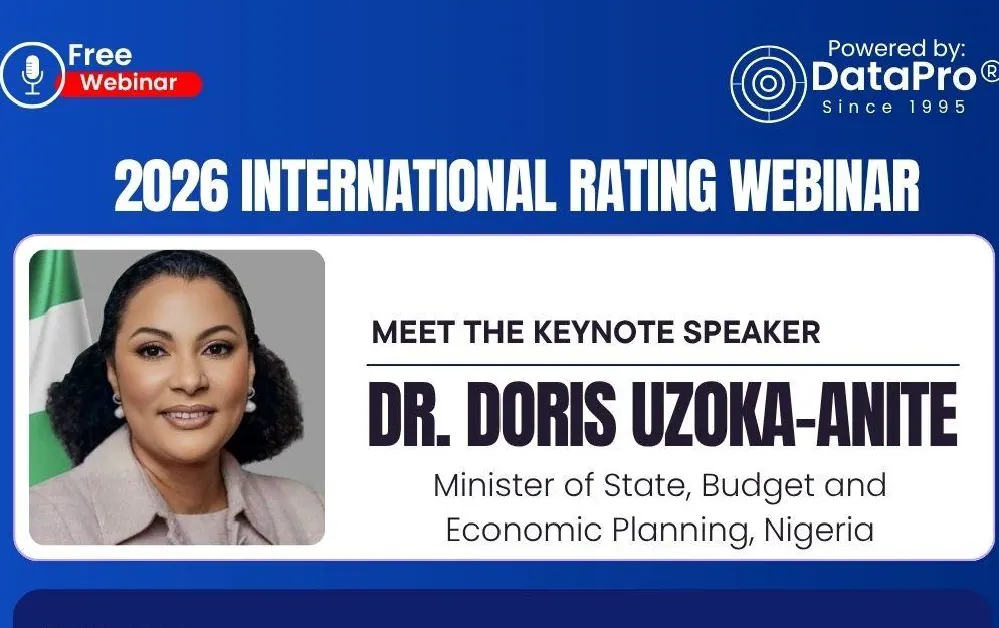
The Federal Government of Nigeria has set a target of 2030 to secure an investment-grade sovereign credit rating. This move is aimed at strengthening the country's economic and financial standing in the eyes of investors. The government will present its strategy at the 6th International Rating Webinar organised by DataPro.
The Minister of State for Budget and Economic Planning, Dr. Doris Uzoka-Anite, will deliver the keynote address at the webinar. Her address, titled "Achieving Investment Grade Rating by 2030: The Roadmap for Nigeria," will outline the measures the government plans to adopt to improve Nigeria's sovereign credit profile. An investment-grade rating is generally associated with a country's ability to meet its debt obligations and maintain economic policies that give investors greater confidence.
Achieving an investment-grade rating could strengthen Nigeria's position when seeking international financing and improve the perception of the country's investment environment. The government's roadmap will focus on reforms covering public finances, economic policy, and institutions. Particular attention will be given to how these areas affect the assessment of Nigeria's sovereign risk. A key part of the discussion will be the need for the government to produce more credible budgets and improve transparency in the management of public finances.
Uzoka-Anite will explain how more reliable fiscal planning and clearer information on government finances can strengthen confidence among investors and other participants in the financial markets. The minister will also address the relationship between fiscal policy, driven by government spending and taxation, and monetary policy managed by the Central Bank of Nigeria. Closer coordination between the two sides is necessary to create a more predictable economic environment and reduce uncertainty around policy decisions.
The planned reforms will also extend to public institutions and regulatory bodies. The government believes that stronger institutions and better implementation of policies are necessary to improve investor confidence and strengthen Nigeria's assessment by credit rating agencies. The webinar will provide an opportunity to examine the institutional weaknesses and governance challenges that can affect the way countries are assessed by rating agencies.
Experts from the Ministry of Finance Incorporated (MOFI), the African Peer Review Mechanism (APRM), and international academic institutions will participate in the discussions. They will examine how different countries have approached economic and institutional reforms and discuss the technical indicators used by rating agencies when assessing sovereign risk. The event will also examine the experience of other African countries seeking to improve their sovereign credit ratings.
For Nigeria, the 2030 target places greater attention on the quality and consistency of economic reforms as the government seeks to improve its standing in international financial markets. The discussions at the DataPro webinar will focus on the desired rating and the economic and institutional changes required to create the conditions for achieving it. The government's position is that stronger public financial management, credible economic policies, and effective institutions will be important to building the level of confidence required for Nigeria to attain investment-grade status by 2030.
Key points
- The Nigerian government aims to secure an investment-grade sovereign credit rating by 2030.
- The government will present its strategy at the 6th International Rating Webinar organised by DataPro.
- Achieving an investment-grade rating could strengthen Nigeria's position when seeking international financing.