Ahead of the 2027 general election in Nigeria, concerns have been raised about the accuracy of the country's voter register. Unlike some countries, such as the United Kingdom and United States, which regularly update their voter registers to remove deceased individuals, Nigeria's register still contains names of people who have passed away. Sections 12 and 19 of the Nigerian Electoral Act require the Independent National Electoral Commission (INEC) to maintain a clean and updated register, but this has not been effectively implemented.
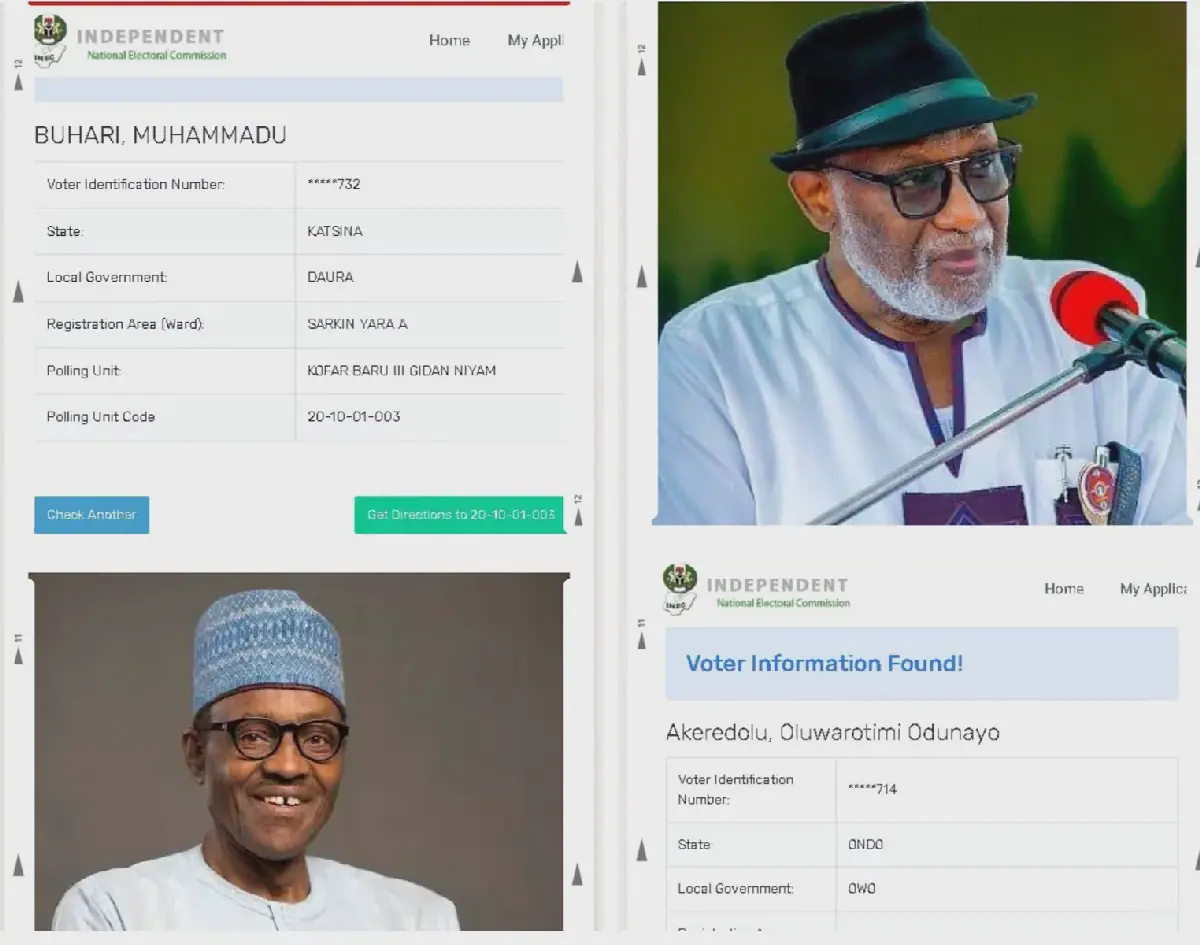
A recent test conducted by Dubawa, a fact-checking organization, found that the names of deceased public figures, including former President Muhammadu Buhari and former Ondo State Governor Rotimi Akeredolu, are still active on the INEC voter portal. This is despite their deaths in 2025 and 2023, respectively. The presence of these names on the register has raised concerns about the integrity of the electoral process and the potential for inaccurate post-election analysis.
INEC has acknowledged the issue of deceased persons on the voter register and has previously announced plans to conduct a nationwide voter revalidation exercise to sanitize its database. However, the exercise was later canceled due to time constraints and opposition from some Nigerians. As a result, the voter register remains littered with an unknown number of deceased names, which could skew post-election analysis and affect the accuracy of voter turnout calculations.
The issue of an inaccurate voter register is not new, and INEC has faced criticism in the past for its inability to remove deceased persons from the register. In 2022, Festus Okoye, then INEC National Commissioner, cited the lack of data on births and deaths as a challenge to cleaning up the register. The National Population Commission has also raised concerns about the country's low civil registration coverage, with only 57% of births and less than 20% of deaths officially registered.
Despite these challenges, INEC has announced that over 103 million people are eligible to vote based on the current register. However, this figure may be misleading due to the presence of deceased names on the register. Political analyst Jide Ojo has argued that using this figure as the baseline for post-election analysis could produce misleading interpretations, particularly with regards to voter turnout calculations.
The presence of deceased persons on the voter register also raises concerns about the potential for electoral manipulation. If deceased individuals are still listed on the register, it could create opportunities for vote rigging or other forms of electoral malfeasance. INEC has a responsibility to ensure the integrity of the electoral process, and cleaning up the voter register is a critical step in achieving this goal.
As the 2027 general election approaches, it remains to be seen whether INEC will take steps to address the issue of deceased persons on the voter register. The commission's decision to cancel the voter revalidation exercise has been criticized by some, who argue that it is essential to ensure the accuracy of the register. Ultimately, the integrity of the electoral process depends on the accuracy of the voter register, and INEC must take steps to address this issue.
Key points
- Nigeria's voter register still contains names of deceased persons, potentially skewing post-election analysis.
- INEC has faced criticism for its inability to remove deceased persons from the voter register.
- The presence of deceased persons on the voter register raises concerns about electoral manipulation and the integrity of the electoral process.