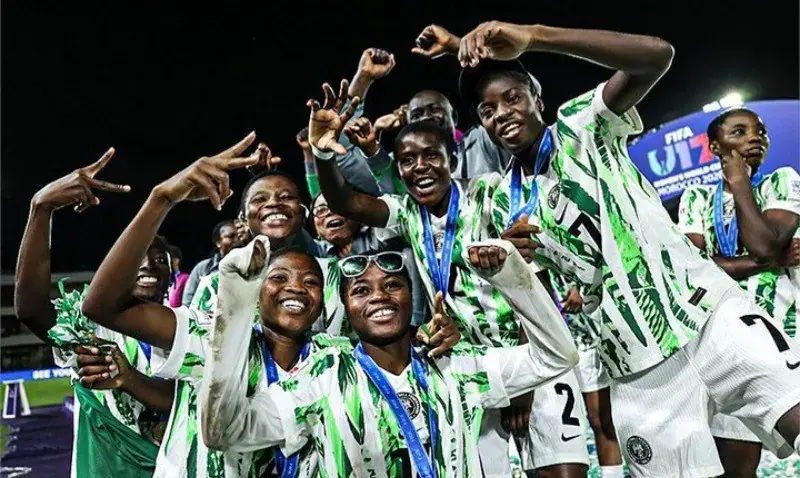
Nigeria's U-17 women's football team, the Flamingos, has made history by becoming the first African team to win the FIFA U-17 Women's World Cup. They defeated Japan 2-1 in the final, held in Rabat, Morocco, on Saturday. The team's journey to the title was remarkable, with the Flamingos recovering from a 2-1 loss to Poland in their opening match to win six consecutive matches. Their victories included wins over Puerto Rico, North Korea, Mexico, Venezuela, Brazil, and Japan.
The Flamingos' success has raised hopes for women's football in Nigeria, but stakeholders emphasize that the real test will be whether the Nigeria Football Federation (NFF) and government invest in a system capable of producing and sustaining more world-class players. The team's star players, including Awawu Bashiru and Oluebube Umejiaku, have credited teamwork and discipline for their victory. Umejiaku, who started the tournament on the bench, emerged as one of the competition's outstanding players, winning the Golden Ball award.
The victory has attracted official recognition and financial rewards for the team. Businessman Alhaji Saleh Ahmadu presented the team with a $50,000 cash gift, while the National Sports Commission announced that outstanding bonuses covering the team's qualifying campaign through to the final had been facilitated for payment. President Bola Tinubu also congratulated the players, describing their triumph as an inspiration to young Nigerian girls.
Despite the celebratory atmosphere, experts stress that the players need long-term support, including access to competitive football, quality coaching, education, and proper career management. Former Nigeria Football Federation board member and former FIFA Women's Football Committee member, Hulayat Motunrayo Omidiran, believes the victory should become a turning point for women's football development in Nigeria.
Omidiran emphasizes that Nigeria must not wait for another generation of Flamingos to emerge by chance. Instead, the country needs a deliberate system that identifies talents early, develops them properly, protects them, and provides a clear pathway for their careers. This system would enable the country to build on the success of the Flamingos and ensure that the players do not fade into obscurity after their moment of glory.
The Flamingos' journey to the title was marked by remarkable comebacks and victories. They defeated Brazil in the semi-finals, with Bashiru scoring twice, and Umejiaku doubling Nigeria's lead in the final. Japan pulled one back through Fuki Ito in the 80th minute, but Nigeria held on to secure the trophy. The team's success has sparked hopes that women's football in Nigeria can be transformed.
As Nigeria celebrates the Flamingos' historic victory, the focus is shifting to the future of women's football in the country. With the right investment and support, stakeholders believe that Nigeria can build on this success and become a powerhouse in women's football. The country's football authorities and government face the challenge of creating a sustainable system that will enable the Flamingos to continue thriving.
Key points
- Nigeria's U-17 women's football team wins FIFA U-17 Women's World Cup, sparking hopes for women's football development
- Stakeholders emphasize the need for sustainable investment in women's football to build on the team's success
- Experts call for a deliberate system to identify and develop talents, protect players, and provide clear career pathways