Nigeria has spent trillions of naira on capital projects designed to expand productive capacity, improve infrastructure, and turn the country's natural resources into economic value. However, decades later, many of these projects remain unfinished, abandoned, or operating far below their intended capacity. The failures cut across sectors including power, agriculture, manufacturing, transport, and public infrastructure. A review by BusinessDay found that the valuation of these projects is at least $9.908 billion, with tens of billions of naira spent without delivering the economic output they were designed to generate.
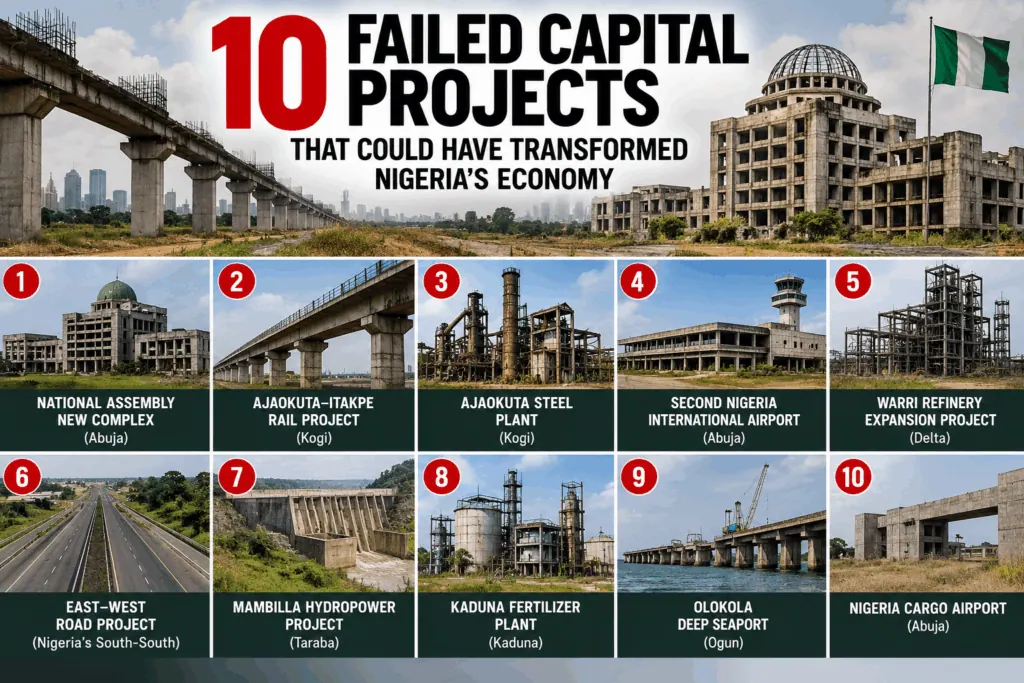
The projects, conceived to expand electricity generation, industrial production, transport capacity, agricultural output, and exports, have instead left billions of dollars in planned capacity tied up in assets that have yet to deliver their intended economic value. BusinessDay examined 10 major projects, including the Mambilla and Gurara II hydropower plants, Eastern Railway, Ajaokuta Steel Company, Baro Inland Port, Brass and Olokola LNG projects, Zauro Polder Irrigation Project, NIMASA's floating dockyard, and ALSCON. These projects have been plagued by years of delays, litigation, financing problems, and failed revival attempts.
The NIMASA floating dock project, valued at N40.24 billion, was meant to provide affordable maintenance and repair for cabotage vessels. However, NIMASA eventually acknowledged that the proposed location could not accommodate it. Five years after arriving in 2018, preparations for its operation are still underway. The ICRC projected the dock could generate $65.61 million over 15 years and more than 800 jobs. However, as of 2025, Nigeria loses an estimated $147.8 million in docking fees, repair services, and other additional costs for each vessel yearly.
In the power sector, the Mambilla Hydropower Plant, whose feasibility study was initially carried out in 1972, has failed to generate electricity despite a 2017 construction agreement valued at $5.79 billion for 3,050 MW. The project was conceived as a major power plant project in Taraba State meant to substantially increase the country's electricity generation. However, corruption has tied the project in litigation for many years. Two weeks ago, the Presidency announced that a tribunal had rejected a $680 million-plus-interest claim by the contractor, Sunrise Power.
The Mambilla project, if completed, would have been the largest power-generating installation in the country and one of the largest hydroelectric power stations in Africa. Its installed capacity alone would be equivalent to about 64 percent of Nigeria's average available grid capacity in August 2026. In 2025, Nigerian manufacturers spent N1.35 trillion on alternative power, up more than 21 percent from a year earlier. The World Bank estimates the nationwide economic toll of unreliable electricity in Nigeria at roughly $29 billion annually.
Transport projects, such as the Port Harcourt-Maiduguri Eastern Railway, have also faced similar problems. The project was launched as a roughly $3.2 billion rehabilitation programme, but a government study eventually showed that the contractor could not secure the loan component required for the project, forcing the government to fund construction itself. Although Port Harcourt-Aba has reopened, the wider corridor remains unfinished, leaving Nigeria without a functioning east-north freight corridor.
Other projects, such as Ajaokuta Steel Company, Baro Inland Port, and ALSCON, have also failed to achieve their intended objectives. Ajaokuta was conceived as the centrepiece of Nigeria's steel industry, with a planned capacity of five million tonnes annually, but it has yet to achieve integrated commercial production. Abubakar Audu, Nigeria's minister of steel, estimated that Nigeria spends about $4 billion annually on iron and steel imports. The country's failure to complete these projects has resulted in significant economic costs, including lost jobs, industrial output, foreign exchange, and private investment.
Key points
- Nigeria has spent at least $9.908 billion on failed capital projects.
- The country's unreliable electricity supply costs roughly $29 billion annually.
- Decades of stalled projects have cost Nigeria jobs, industrial output, foreign exchange, and private investment.