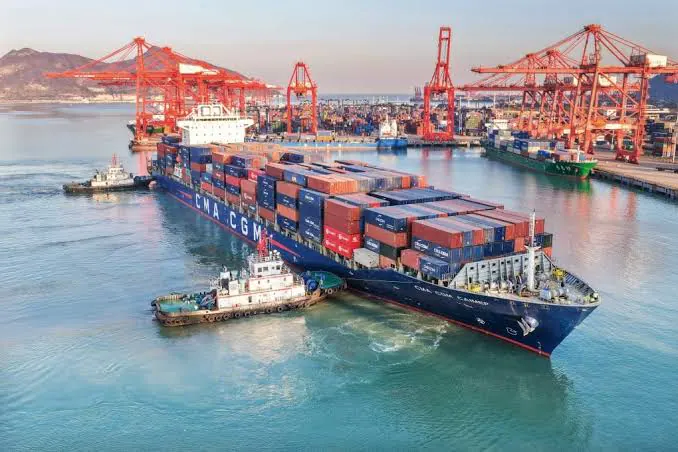
Nigeria's ports must significantly increase their cargo handling capacity to support the country's ambition of becoming a $1 trillion economy by 2030. Currently, the economy is valued at $377 billion, according to the IMF. To achieve this goal, consumer spending, government spending, investment, and the balance of payments surplus would each need to roughly triple. Maritime experts emphasize that the port system must be able to handle at least three times the amount of imports and exports it currently processes.
The current state of Nigeria's ports, particularly those at Apapa and Tin Can, has been plagued by congestion and slow cargo clearance, hindering operations and competitiveness. According to Emeka Akabogu, senior partner at Akabogu and Associates, cargo dwell time can reach 20 days at some of Nigeria's busiest container ports, compared to 24 or 48 hours in efficient ports like Singapore and Rotterdam. Frank Aigbogun, publisher of BusinessDay Media Ltd, shared his experience of a cargo shipment that took 12 days to clear at Customs, highlighting the need for improvement.
In 2025, Nigeria recorded a total cargo throughput of 129.3 million metric tonnes, with half-year throughput standing at 68.2 million metric tons and 815,236 TEUs. However, this is still far behind the capacity of ports in countries with similar economies. For instance, Chinese ports handled 18.3 billion metric tons of cargo and 354 million TEUs in 2025, while the Port of Singapore, with a GDP of $659 billion, handled 614.34 million tons of cargo and 44.66 million container TEUs.
To handle triple the current capacity, Akabogu emphasized the need for both more physical port capacity and greater efficiency in moving cargo through existing facilities. He noted that at least 27 government agencies are involved in cargo clearance, with importers required to satisfy their requirements sequentially. The National Single Window, launched in March 2026, aims to streamline the process, but its implementation has not fully met expectations.
Stakeholders stress that digitalization is crucial to redesigning port processes, reducing transaction time, eliminating duplication, improving transparency, and lowering the cost of doing business. Vivian Chimezie, director general of the Nigerian Chamber of Shipping, emphasized that ambition must go beyond putting existing processes online. Jama Onwubuariri, co-founder of TTP Limited, highlighted the need for standardized port procedures, citing the Eto call-up system's efforts to curb congestion.
The reform efforts have been stalled by competing interests in the port sector, with Onwubuariri's firm awaiting approval to deploy eTags since June 2023. Bernard Orji, a representative of Deloitte West Africa, noted that Nigeria's port capacity challenge extends beyond the port gates, requiring better road, rail, and inland-waterway connections to support the growth in cargo volumes.
The newly established Nigerian Port Economic Regulatory Act is expected to play a key role in the reforms needed to address gaps in the relationships between shippers, carriers, and terminal operators. Akabogu emphasized that the new port economic regulator should provide a framework for resolving disputes, with the broader objective of maximizing the economic value generated by the ports rather than focusing primarily on government revenue.
Key points
- Nigeria's ports need to triple cargo capacity to meet $1 trillion economy target by 2030.
- Current port congestion and slow cargo clearance hinder operations and competitiveness.
- Digitalization is crucial to redesigning port processes and improving efficiency.