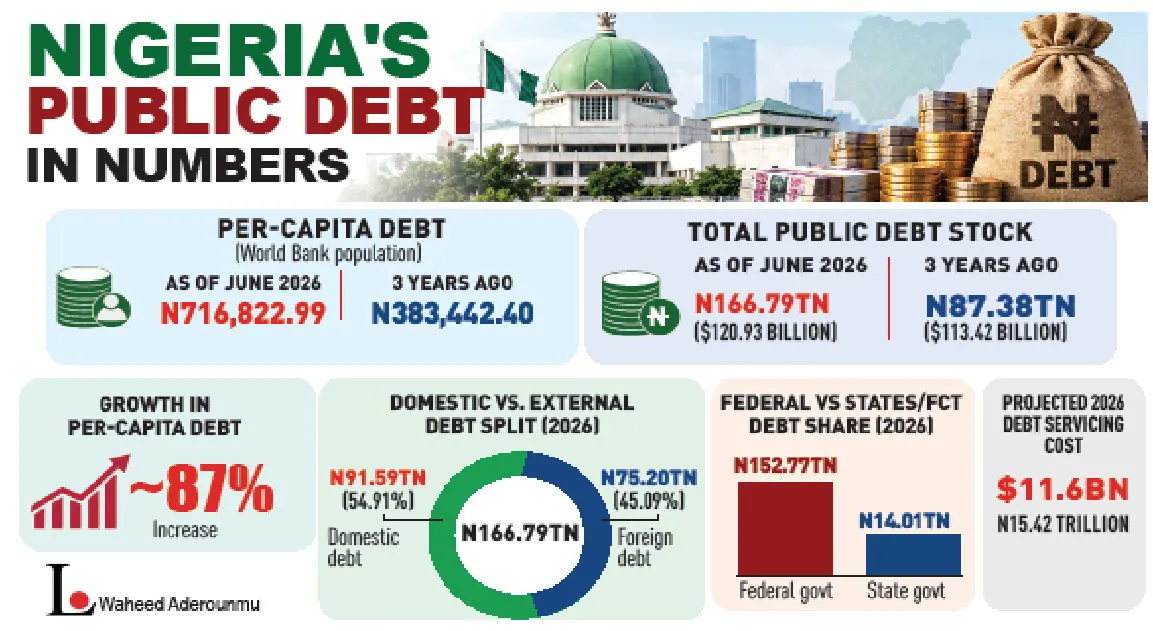
Nigeria's public debt burden has sparked concern among economists and the public, with fresh calculations showing that every Nigerian now carries an estimated N716,822 in public debt. This figure is based on the latest data from the Debt Management Office (DMO) and the World Bank's population estimates. The debt burden has increased by 87% from three years ago, when it stood at N383,442 per person.
According to the DMO, Nigeria's total public debt stock has grown to N166.79 trillion as of June 30, 2026, up from N87.38 trillion three years ago. The World Bank estimates the population at 232,679,478, which results in the per-capita debt burden of N716,822. This represents an increase of N333,380 per person over the three-year period.
Economists have warned that the pace of borrowing is outstripping the country's capacity to service its debt. Debt-servicing costs are projected to reach $11.6 billion in 2026, up sharply from the previous year. Recurrent government spending continues to rise, adding to concerns about debt sustainability.
The per-capita debt burden varies depending on the population estimate used. Based on the National Population Commission's (NPC) projection of 216 million, the current per-capita debt burden rises to roughly N772,175. Analysts note that part of the naira-denominated surge reflects currency depreciation rather than new borrowing alone.
The naira has depreciated significantly over the past three years, with the official exchange rate falling from N769.25/$1 in June 2023 to about N1,329/$1 in September 2026. This represents a depreciation of about 72.8%. As a result, Nigeria's dollar-denominated debt grew moderately, from $113.6 billion to $120.93 billion.
When per-capita debt is weighed against per-capita income, a more troubling picture emerges. According to World Bank data, Nigeria's GDP per capita stood at roughly $1,596.6 in 2023. At the June 2023 exchange rate, this translated to approximately N1,228,378 per person. The per-capita public debt of N383,442 at that time represented a smaller share of average income.
The rising debt burden has renewed debate about debt sustainability in Nigeria. Economists are urging caution, warning that the country's borrowing pace must be carefully managed to avoid undermining economic stability. The government faces challenges in balancing its spending needs with the need to service its debt and maintain economic growth.
Key points
- Nigeria's public debt per citizen has risen to N716,822, up 87% from three years ago.
- Economists warn that the pace of borrowing is outstripping the country's capacity to service its debt.
- The government's debt-servicing costs are projected to reach $11.6 billion in 2026.