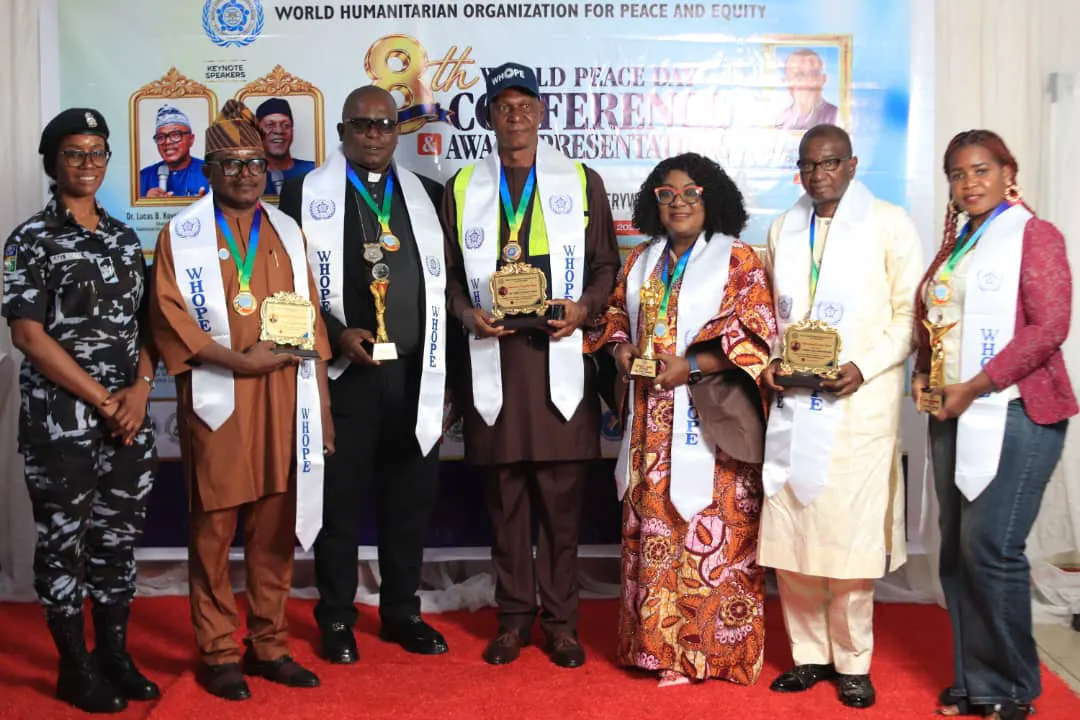
The World Humanitarian Organization for Peace and Equity (WHOPE) has emphasized the need for greater investment in justice, employment, education, and dialogue to build sustainable peace in Nigeria. This call was made at the organisation's 8th Annual World Peace Day Conference, held at the Lagos Chamber of Commerce and Industry in Ikeja, Lagos. The conference had the theme, "Invest in Peace – For Everyone, Everywhere, Everyday."
According to WHOPE President, Chaplain Dr. James Mercy Obatunmibi, peace must be deliberately built, nurtured, and protected through continuous investment. He stressed that peace went beyond the absence of violence and identified education, youth empowerment, justice, strong families and communities, inclusive institutions, and dialogue as key areas requiring investment.
Obatunmibi urged political leaders to manage differences through lawful processes rather than intimidation, hatred, or violence. He also called on religious and traditional leaders to promote reconciliation and tolerance, while urging security agencies to uphold professionalism, discipline, and respect for human rights.
Cosmas Olatunde Oluyemo, a speaker at the conference and retired Deputy Director of the National Orientation Agency (NOA) Lagos state, noted that Nigeria's peace-building efforts were being challenged by insecurity, banditry, kidnapping, terrorism, ethnic rivalry, poverty, unemployment, social injustice, inequality, and struggles for political power and control of resources.
Oluyemo emphasized that peace was essential to national development because businesses and investors would be reluctant to commit resources to an unstable environment. He identified open dialogue, social justice and equity, employment opportunities, interfaith cooperation, tolerance, peace education, effective governance, and a sound business environment as measures needed to promote sustainable peace.
Oluyemo urged the government to ensure fair distribution of national resources and political opportunities, while calling on the private sector to create jobs and civic opportunities for young people. He also stressed the need for stronger efforts to tackle misinformation and inflammatory content on social media, particularly among young people.
Both speakers stressed that peace-building was not the responsibility of government alone, urging parents, teachers, religious and traditional leaders, journalists, businesses, civil society organisations, and ordinary citizens to contribute to peaceful coexistence. They called for peace to become an everyday commitment rather than an issue remembered only on World Peace Day.
Key points
- WHOPE calls for investment in jobs, justice, education, and dialogue to build sustainable peace in Nigeria.
- Peace-building is not the responsibility of government alone.
- Peace is essential to national development and requires commitment, sacrifice, and continuous investment.