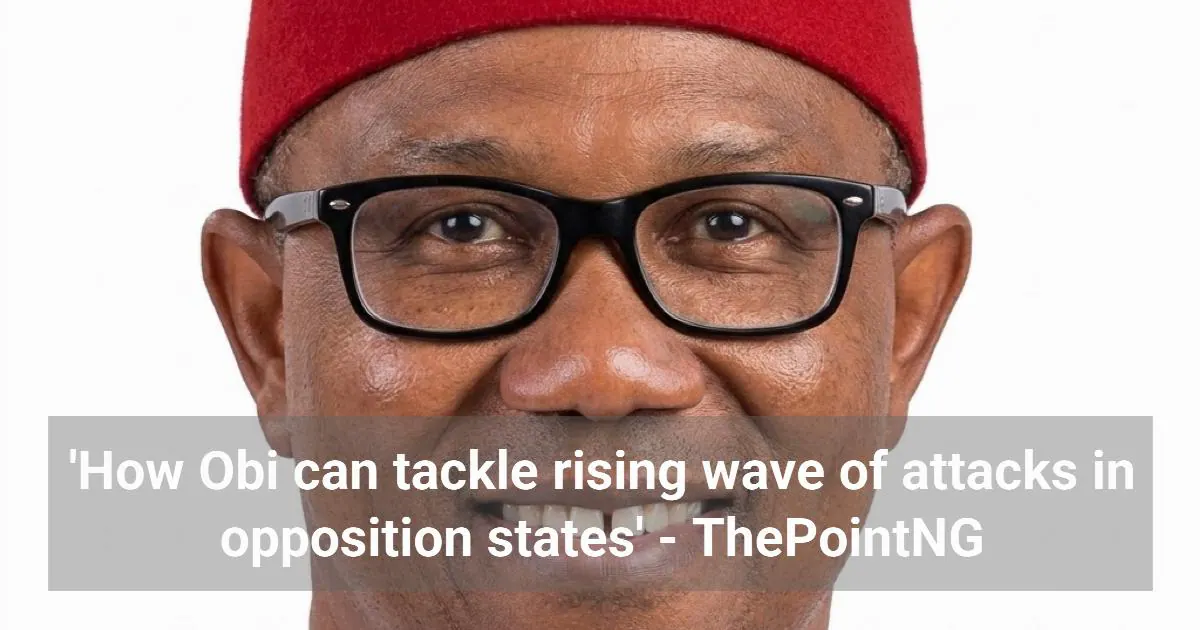
A wave of political intolerance is sweeping across Nigeria, targeting Peter Obi, the prominent opposition leader and presidential frontman of the Nigeria Democratic Congress. Recent high-profile confrontations in Benue and Delta states have raised urgent constitutional concerns across the federation. The escalating friction has triggered a fierce national debate among top legal minds and political commentators regarding the root causes of this hostility and what Obi must do to navigate the increasingly hostile landscape.
The most severe physical flashpoint occurred on September 8, 2026, along the Gboko-Makurdi Expressway in Benue State. Obi's convoy was violently intercepted by a stick-wielding mob in broad daylight. The hostile crowd erected makeshift blockades on the federal highway, pelting Obi's vehicles with stones, logs, and debris while chanting aggressive partisan slogans. The Benue State NDC Publicity Secretary, Agile Bem Ordedoo, accused operatives aligned with the ruling All Progressives Congress of mobilizing thousands of thugs to forcibly block the relief mission.
The hostility followed Obi into Delta State just ten days later, proving that the trend was not geographically isolated. On September 18, 2026, violent chaos erupted at the Osubi Airport terminal in Warri, where enthusiastic NDC mobilizers and supporters had gathered peacefully to welcome Obi. Eyewitnesses reported that suspected political thugs systematically infiltrated the terminal grounds, aggressively attacking the assembly with weapons while local security personnel initially stood by without intervening.
Beyond grassroots thuggery and highway blockades, Obi faces a much more calculated and institutionalized form of systemic resistance from sitting state executives. The most prominent institutional dispute centres around Edo State Governor Monday Okpebholo, who in July 2025 issued a stern decree warning Obi against stepping foot in Edo territory without explicit, prior written security clearance from the state government.
The friction escalated rapidly after Obi visited Benin City to make a ₦15 million humanitarian donation to a local nursing school. Governor Okpebholo claimed that Obi's unannounced arrival sparked a wave of regional unrest that ultimately cost three citizens their lives. The direct warning drew immediate, widespread condemnation from the legal community, with renowned human rights attorney Femi Falana publicly admonishing the governor for violating Section 33 of the Nigerian Constitution.
A unified caucus of senators from Obi's former party, the Labour Party, also issued an explosive joint statement, labelling Okpebholo's warning a display of "sheer executive lawlessness and impudence." The lawmakers noted that Section 41(1) of the 1999 Constitution of the Federal Republic of Nigeria explicitly guarantees absolute freedom of movement for all citizens, regardless of their political affiliation or status.
Analyzing these developments, various stakeholders are calling for a re-evaluation of the nation's democratic trajectory. The situation has sparked concerns about the potential erosion of democratic values and the need for a more robust protection of opposition leaders' rights.
Key points
- The opposition leader, Peter Obi, faces increasing violence and restrictions in states controlled by rival parties.
- The incidents have sparked concerns about the nation's democratic journey and the potential erosion of democratic values.
- Legal experts and lawmakers have condemned the actions of state executives, citing violations of the Nigerian Constitution.