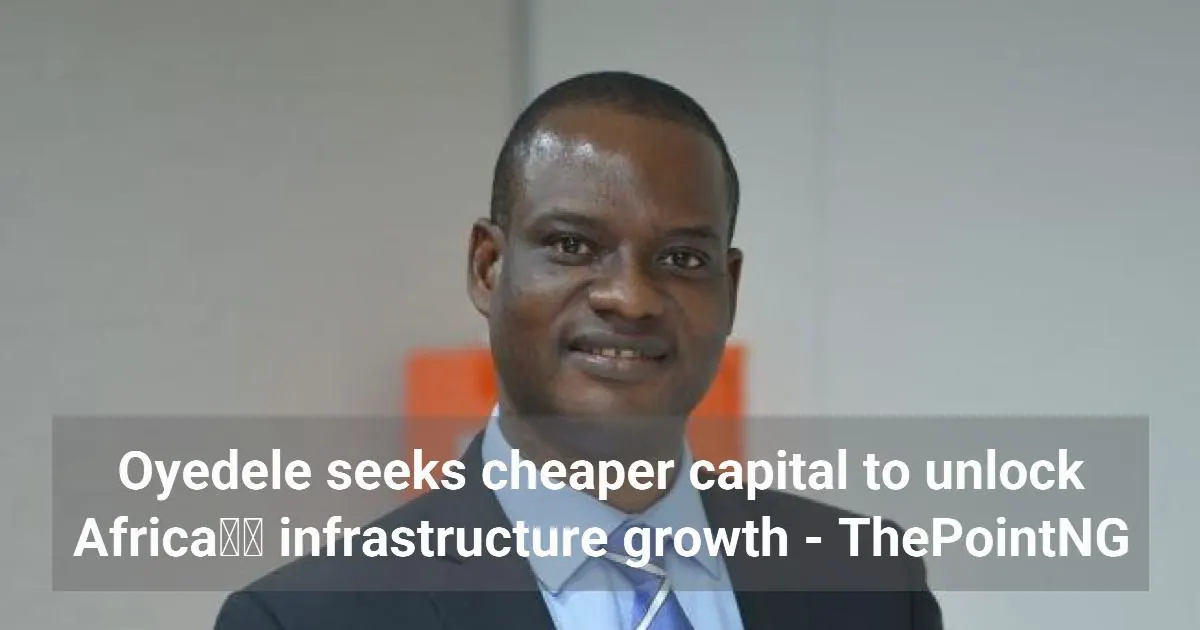
Nigeria's Minister of Finance and Coordinating Minister of the Economy, Taiwo Oyedele, has called for more affordable financing to enable African countries to bridge their infrastructure gaps and meet their development objectives. Oyedele made the call at the United Nations Dialogue on Solutions to Climate Finance in New York, held on the sidelines of the 81st Session of the United Nations General Assembly. His position was disclosed in a statement issued by the Head of Information and Public Relations of the Ministry of Finance, Efe Ovuakporie.
Oyedele identified expensive financing, exposure to currency risks, and inadequate access to long-term capital as major challenges undermining Africa's development aspirations, particularly in the energy sector. He described the additional burden facing African countries in accessing capital as a "prejudice premium" and "narrative cost". These factors, according to him, are making it more difficult for the continent to secure funding for essential infrastructure.
The Minister further identified currency risks and what he termed "stereotype tax" among the challenges increasing the cost of financing energy and other development projects across African countries. He urged the global community to reconsider existing financing arrangements and develop simpler and more affordable mechanisms that take into account the economic and developmental circumstances of developing countries.
Oyedele advocated for greater investment in gas and other transition energy sources, particularly across Africa, arguing that increased funding for the sector would help address the continent's persistent energy-access challenges. He said expanding investment in Africa's energy infrastructure would provide more reliable and affordable energy while contributing to efforts to tackle energy poverty globally.
Increased investment in the continent could also broaden the sources of global energy supply and reduce the risks associated with excessive dependence on a limited number of supply regions. Oyedele noted that diversification had become increasingly important in view of disruptions affecting the Gulf region and their potential implications for global energy security.
Oyedele stressed that Africa's energy transition should take into account the continent's substantial deficit in access to electricity and other forms of modern energy. He maintained that African countries required significantly greater investment to meet their development objectives while pursuing realistic pathways towards cleaner energy.
For Nigeria, Oyedele said the immediate focus of government should remain on policies and programmes capable of reducing poverty and creating wider economic opportunities for citizens. He emphasised that achieving these objectives would require stronger international collaboration as well as a financing framework that was more responsive to the needs of developing economies.
Key points
- Oyedele calls for more affordable financing to bridge Africa's infrastructure gaps
- Expensive financing, exposure to currency risks, and inadequate access to long-term capital undermine Africa's development aspirations
- Increased investment in Africa's energy infrastructure could broaden global energy supply sources and reduce associated risks