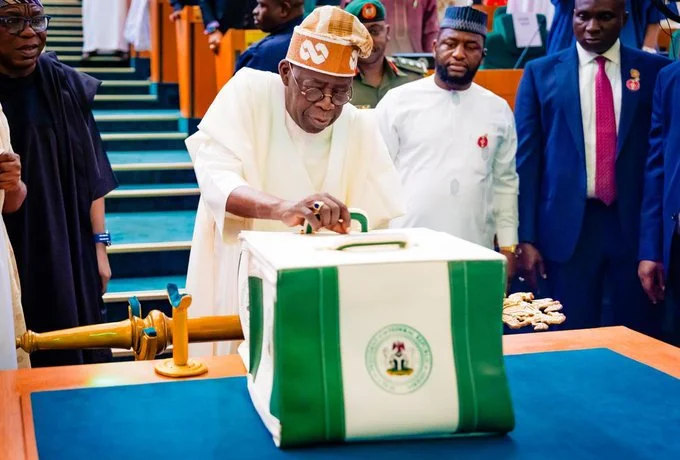
In December 2025, President Bola Ahmed Tinubu declared that Nigeria would no longer run multiple budgets on the same revenue inflow, a longstanding fiscal problem. He presented the 2026 Appropriation Bill, stating that by March 31, 2026, all capital liabilities from previous years would be fully funded and closed. From April 2026, Nigeria would operate on a single budget backed by a single revenue cycle. However, nine months later, the President assented to the Appropriation (Amendment) (No.4) Bill, 2025, extending the implementation of the 2025 budget from September 30 to December 31, 2026.
The Presidency explained that the extension would give Ministries, Departments and Agencies more time to complete ongoing capital projects and ensure that funds already appropriated were fully utilised. This decision exposes the difficulty of reconciling the latest extension with the fiscal reset announced by President Tinubu less than a year ago. The 2025 budget will now run well beyond the March 31 deadline for closing previous-year capital liabilities and the April 2026 date for the beginning of a single budget and revenue cycle.
This is not the first adjustment to the 2025 budget timeline. Earlier in 2026, the implementation period of the capital component of the 2025 Appropriation Act was extended beyond its original deadline, citing the need to complete critical infrastructure and ongoing projects. The latest amendment has pushed the deadline to December 31. The development is significant, as the administration had identified overlapping appropriations as a problem requiring an exceptional fiscal reset.
President Tinubu's December 2025 budget speech highlighted that multiple budgets, abandoned projects, inherited obligations and perpetual rollovers had undermined governance and economic planning. His proposed solution was not merely to improve the execution of existing budgets but to terminate the practice altogether. However, Nigeria's struggle with budget-cycle discipline predates the Tinubu administration, stretching across successive civilian administrations since 1999.
Under former President Olusegun Obasanjo, major public financial management reforms were introduced, including the Medium-Term Expenditure Framework, to improve fiscal planning and reduce vulnerability to fluctuations in oil revenue. Despite this, the transition to a predictable annual budget cycle remained difficult. Delays in budget enactment continued under subsequent administrations, including those of President Umaru Musa Yar'Adua, Goodluck Jonathan, and Muhammadu Buhari.
The World Bank found that federal budgets were enacted an average of five months late between 2015 and 2019, reflecting weak budget predictability. However, there was a significant improvement from 2020, with the 2020 budget enacted before the start of the fiscal year and the 2021 budget signed on December 31, 2020. The Buhari administration described this as a return to the January-to-December budget cycle, but the COVID-19 pandemic disrupted the implementation of the 2020 budget, prompting an extension into 2021.
Economists and financial analysts have raised concerns about the implications of repeated budget rollovers. Dr. Muda Yusuf, Chief Executive Officer of the Centre for the Promotion of Private Enterprise, linked Nigeria's budget implementation difficulties to the credibility of its revenue and expenditure projections. Dr. Muhammad-Bashir Yusuf, an economist at Al-Hikmah University, emphasised the importance of the January-to-December fiscal cycle for government planning, spending, and economic measurement.
Key points
- President Tinubu's administration has extended the 2025 budget to December 31, 2026, despite his pledge to end budget rollovers.
- Nigeria's struggle with budget-cycle discipline predates the Tinubu administration, with successive governments attempting reforms but facing challenges.
- Economists warn that repeated budget rollovers create uncertainty and undermine the credibility of Nigeria's revenue and expenditure projections.